Capital fence

Premium Fencing &
Automated Gates in —
Rio Linda – Built to Last.

Custom Solutions for Residential and Commercial
Properties. Get a Free Quote Today!

Serving Rio Linda and the
surrounding areas

we pride ourselves on delivering top
-quality craftsmanship and exceptional
service.

Automated

Gates

expert for custom fencing,
automated gates, and access
control systems

Your Trusted Fencing Experts

Expert Fencing Solutions
for Rio Linda and Beyond

We Proudly Use The Following Products

Capital Fence Corp is your go-to expert for custom fencing,
automated gates, and access control systems. Serving Rio
Linda and the surrounding areas, we pride ourselves on
delivering top-quality craftsmanship and exceptional service.

What We Offer

Comprehensive Fencing
and Gate Solutions

01

Fencing

From wood to vinyl and chain-link, we design and install fences that enhance security and curb appeal.

02

Gate Doors

Custom gate doors that combine functionality with style, perfect for any property.

03

Automated Gates

State-of-the-art automated gates for convenience, security, and peace of mind.

04

Access Control

Advanced access control systems to secure your property with ease.

Why Choose Capital Fence Corp?

Your Trusted Partner for
Fencing and Automated
Gate Solutions

With years of experience in the fencing and gate industry, we bring expertise and precision to every project. You can trust us to deliver results that exceed your expectations.

Testimonials

What Our Clients Say

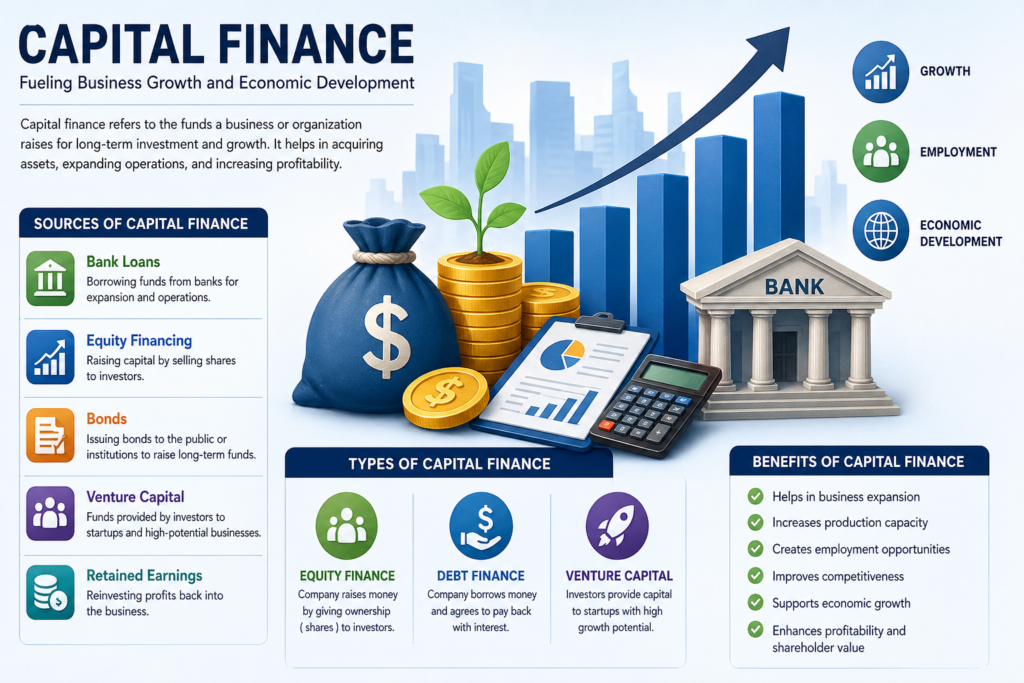
Capital Finance: A Complete Guide for Business Growth


Introduction

Capital finance is one of the most important elements in the world of business and economics. Every business, whether small or large, requires money to start, operate, and expand. This money or funding is known as capital finance. Without proper capital finance, businesses cannot purchase machinery, hire employees, manage daily expenses, or invest in growth opportunities.

In simple words, capital finance refers to the funds used by businesses or organizations to run operations and achieve long-term success. It plays a vital role in business development, industrial growth, employment generation, and national economic progress.

This article explains capital finance in detail, including its meaning, types, sources, importance, benefits, challenges, and future trends.


What is Capital Finance?

Capital finance means the money or financial resources used to support a business or investment project. It can come from the owner’s personal savings, investors, banks, or financial institutions.

For example, if someone wants to open a clothing store, they need money for:

  • Renting a shop
  • Buying stock
  • Paying salaries
  • Marketing expenses
  • Interior setup

The funds used for all these purposes are called capital finance.


Importance of Capital Finance

Capital finance is essential for every business because it provides the resources needed to function properly.

1. Starting a Business

No business can start without investment. Initial capital is needed for setup costs, inventory, and legal requirements.

2. Expansion Opportunities

Businesses need extra capital to grow, open new branches, or launch new products.

3. Daily Operations

Running expenses such as wages, electricity, rent, and transportation need working capital.

4. Innovation and Technology

Companies invest in new technology and systems through proper financing.

5. Economic Growth

When businesses grow, they create jobs and contribute to national income.


Types of Capital Finance

Capital finance can be divided into several categories.

1. Equity Finance

Equity finance means raising money by selling shares of the company to investors.

Advantages:

  • No loan repayment pressure
  • Investors share risk
  • Suitable for long-term growth

Disadvantages:

  • Ownership is shared
  • Profits are divided among shareholders

2. Debt Finance

Debt finance means borrowing money from banks or lenders.

Examples:

  • Bank loans
  • Bonds
  • Business credit lines

Advantages:

  • Ownership remains with owner
  • Fixed repayment terms

Disadvantages:

  • Interest payments
  • Financial pressure if profits are low

3. Working Capital Finance

This is short-term finance used for day-to-day expenses.

Examples:

  • Salaries
  • Bills
  • Rent
  • Stock purchase

Working capital keeps business operations running smoothly.


4. Fixed Capital Finance

This finance is used for long-term assets.

Examples:

  • Buildings
  • Machinery
  • Vehicles
  • Furniture

Main Sources of Capital Finance

Businesses can get finance from many sources.

1. Personal Savings

Many entrepreneurs use their own money.

2. Family and Friends

Small businesses often borrow from close contacts.

3. Banks

Commercial banks offer loans for business needs.

4. Investors

Angel investors and venture capitalists invest in startups.

5. Government Schemes

Governments provide support loans for SMEs and youth businesses.

6. Stock Market

Large companies raise capital by selling shares publicly.


Benefits of Capital Finance

Capital finance offers many advantages.

Business Growth

Companies can increase production and sales.

Better Cash Flow

Finance helps manage daily payments and avoid shortages.

Competitive Advantage

Well-funded companies can advertise more and improve products.

Job Creation

Expansion leads to hiring more employees.

Increased Profits

More investment often creates higher returns.


Challenges of Capital Finance

Although useful, capital finance also has challenges.

1. Loan Repayment Pressure

Debt financing requires monthly payments.

2. Interest Costs

Loans become expensive due to high interest rates.

3. Loss of Ownership

Equity financing reduces full control.

4. Risk of Failure

Poor financial planning can lead to losses.

5. Credit Approval Problems

Small businesses may struggle to get loans.


Capital Finance for Small Businesses

Small businesses need smart financial planning because they usually have limited funds.

Tips for Small Businesses:

  • Start with a realistic budget
  • Avoid unnecessary debt
  • Build good credit history
  • Track expenses carefully
  • Reinvest profits

Small business owners who manage finance wisely can grow steadily.


Capital Finance in Pakistan

Capital finance is very important for Pakistan’s economy. Many businesses rely on financial support for growth.

Major Sources in Pakistan:

  • Commercial banks
  • Islamic banks
  • SME loan schemes
  • Government youth programs
  • Pakistan Stock Exchange

Improved access to finance can help reduce unemployment and increase exports.


Islamic Capital Finance

Islamic finance avoids interest and promotes ethical business practices.

Popular Methods:

  • Mudarabah – Profit sharing
  • Musharakah – Partnership investment
  • Murabaha – Cost plus financing
  • Ijara – Leasing system

These methods are widely used in Muslim countries.


Modern Trends in Capital Finance

Technology has changed the finance world.

Digital Lending

Online platforms now offer quick loans.

Crowdfunding

Businesses raise money from many people online.

FinTech Solutions

Apps help manage accounting, payments, and investments.

Global Investment

Investors can fund businesses across borders.


How to Manage Capital Finance Successfully

To use capital finance effectively:

  1. Make a proper business plan
  2. Estimate required funds correctly
  3. Compare loan options
  4. Maintain financial records
  5. Use funds wisely
  6. Monitor profit and expenses
  7. Reinvest profits for growth

Future of Capital Finance

The future of capital finance is becoming digital, faster, and smarter. AI tools, online banking, blockchain, and digital investment systems are changing how businesses raise and manage funds.

Companies that adapt to modern financial systems will grow faster than others.


Conclusion

Capital finance is the backbone of every successful business. It provides the money needed to start, operate, and expand a company. Whether through equity, loans, or internal savings, proper financing helps businesses achieve growth, create jobs, and support the economy.

In today’s competitive world, understanding capital finance is essential for entrepreneurs, students, and investors. Businesses that manage capital wisely can survive challenges and achieve long-term success.

Capital Finance: A Modern Strategy for Growth and Investment

Introduction

Capital finance is one of the most important foundations of every successful business and economy. Whether a company is small, medium-sized, or multinational, it requires financial resources to operate efficiently, expand into new markets, purchase assets, hire skilled employees, and remain competitive. Capital finance refers to the methods through which organizations raise funds and manage those funds strategically for long-term success.

In the modern business world, capital finance is no longer limited to traditional bank loans. Today, it includes venture capital, equity markets, private investment, crowdfunding, Islamic finance, green bonds, and digital financial technology platforms. These evolving financial tools have transformed the way businesses grow and investors participate in economic development.

What is Capital Finance?

Capital finance is the process of obtaining funds for business use and allocating those resources effectively. It supports both short-term and long-term goals such as daily operations, infrastructure development, modernization, research, and future planning.

Capital is generally divided into two major categories:

  1. Equity Capital – Funds raised by selling ownership shares in the company to investors.
  2. Debt Capital – Funds borrowed from banks or lenders that must be repaid over time with agreed returns or interest.

Both forms of finance play an important role in business success depending on the organization’s size, risk level, and strategic objectives.

Importance of Capital Finance

Capital finance is essential because no business can sustain long-term growth without sufficient funding. It provides the financial strength needed to compete and innovate.

Key Benefits:

  • Supports business expansion and branch development.
  • Maintains healthy cash flow.
  • Helps purchase machinery, land, and technology.
  • Creates employment opportunities.
  • Improves productivity and efficiency.
  • Enables innovation and research.
  • Strengthens the overall economy.

Major Sources of Capital Finance

1. Bank Loans

Commercial banks remain one of the most common sources of capital finance. Businesses use loans for working capital, purchasing assets, or launching new projects.

2. Venture Capital

Startups and innovative companies often rely on venture capital. Investors provide funding to high-growth businesses in exchange for ownership shares.

3. Private Equity

Private equity firms invest in established businesses with strong potential. They help improve management, profitability, and market value.

4. Crowdfunding

Through online platforms, entrepreneurs can collect smaller investments from a large number of people. This is highly effective for startups and creative business ideas.

5. Islamic Finance

Islamic financial models such as Musharakah, Mudarabah, Ijarah, and Sukuk are increasingly popular in Muslim markets because they emphasize ethical and asset-backed financing.

6. Green Finance

Green finance supports environmentally sustainable projects such as renewable energy, clean transport, and eco-friendly infrastructure.

Capital Finance in Pakistan

Pakistan has strong potential for growth in capital finance, particularly in the areas of SMEs, agriculture, manufacturing, and startups. Financial institutions, investors, and government initiatives are gradually supporting entrepreneurship and industrial growth.

Cities such as Karachi, Lahore, and Islamabad are becoming centers of innovation and startup activity. If regulations improve and investor confidence rises, Pakistan can become an attractive destination for regional and international investment.

Role of Technology in Capital Finance

Technology has significantly transformed capital finance. Fintech solutions have made financing faster, easier, and more transparent.

Modern Financial Technologies:

  • Digital banking systems
  • Mobile loan applications
  • Artificial intelligence for credit analysis
  • Blockchain for secure transactions
  • Online investment platforms
  • Automated financial reporting systems

Benefits of Technology:

  • Faster approvals
  • Lower administrative costs
  • Better risk management
  • Improved customer experience
  • Greater financial inclusion

Risk Management in Capital Finance

Every financial decision carries some level of risk. Therefore, companies must manage capital carefully.

Effective Risk Strategies:

  • Avoid excessive borrowing.
  • Diversify funding sources.
  • Maintain emergency cash reserves.
  • Monitor inflation and interest rates.
  • Use professional financial advisors.
  • Conduct regular audits and forecasting.

Real-World Example

Consider a textile manufacturing company that wants to increase exports. It may finance new machinery through a bank loan, raise additional funds through equity investment, and benefit from government incentives. As production increases, exports grow, profits improve, and employment opportunities expand.

Challenges in Capital Finance

Despite its benefits, capital finance also faces several challenges:

  • High interest rates
  • Inflation pressure
  • Currency depreciation
  • Investor hesitation
  • Limited documentation systems
  • Regulatory delays
  • Lack of financial awareness

Solutions for Sustainable Growth

To improve the capital finance environment, governments and institutions should focus on:

  • Increasing financial literacy.
  • Supporting SMEs with affordable loans.
  • Improving digital banking systems.
  • Creating investor protection laws.
  • Encouraging youth entrepreneurship.
  • Promoting transparency and accountability.

Youth Entrepreneurship and New Opportunities

Young entrepreneurs are launching e-commerce stores, software companies, digital agencies, and innovative startups. These businesses require seed funding and startup capital. With proper guidance and financing support, youth-led enterprises can become a major force in economic growth.

Future of Capital Finance

The future of capital finance will be driven by technology, sustainability, and global connectivity. Businesses that adapt to modern funding methods and maintain strong financial discipline will have a clear competitive advantage.

Digital currencies, AI-based lending, sustainable investing, and borderless online capital markets are likely to shape the next era of finance.

Conclusion

Capital finance is the backbone of business development and economic progress. It is not merely about raising money; it is about using resources strategically to create growth, innovation, and long-term value. Companies that understand financial planning and use modern capital tools can achieve remarkable success.

For developing economies such as Pakistan, effective capital finance can unlock investment, generate jobs, and build a stronger future.

Prepared as a fresh professional English article for academic, business, and presentation use.

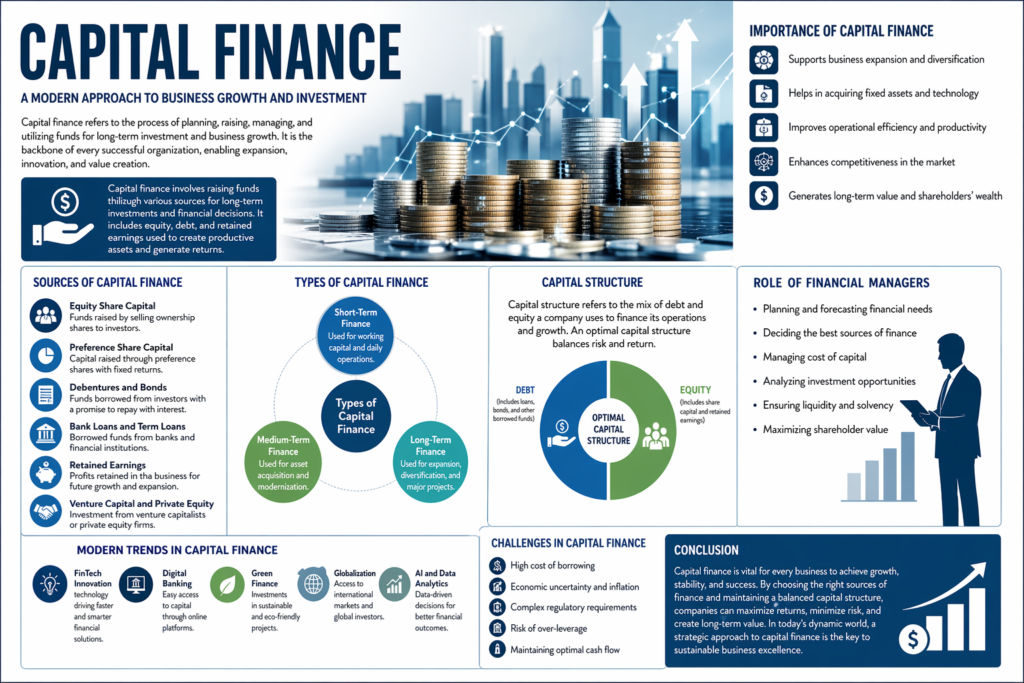
Capital Finance: A Modern Approach to Business Growth and Investment

Cover Image

Introduction

Capital finance is one of the most important areas of business management. It refers to the process of planning, managing, and raising money for business operations, investments, and growth. Every company, whether small or large, needs capital to survive and expand. Without proper finance, businesses cannot buy machinery, hire workers, launch products, or compete in the market.

In the modern world, capital finance has become more advanced because of technology, digital banking, global markets, and changing customer demands. Today, companies use many financial tools such as loans, equity investment, venture capital, bonds, and retained earnings to manage their capital needs.

This article explains the meaning, importance, sources, types, challenges, and future of capital finance in detail.


Meaning of Capital Finance

Capital finance means arranging funds for long-term and short-term business needs. It includes the money used to purchase assets, develop products, pay salaries, and increase production capacity.

The word capital means wealth or resources used to generate more income. Finance means management of money. Therefore, capital finance is the effective use and management of financial resources for business success.

For example:

  • A factory needs money to buy machines.
  • A startup needs money to build an app.
  • A retailer needs money to open new stores.

All these examples are related to capital finance.


Importance of Capital Finance

Capital finance plays a major role in economic development and business success.

1. Business Expansion

Companies need funds to open new branches, launch products, or enter international markets.

2. Purchase of Assets

Businesses buy buildings, vehicles, land, and machinery through capital finance.

3. Daily Operations

Working capital is required to pay rent, salaries, and utility bills.

4. Research and Innovation

Modern businesses need money for technology, software, and innovation.

5. Employment Growth

When businesses grow, they hire more people and create jobs.


Sources of Capital Finance

There are many sources of capital finance available today.

1. Owner’s Capital

This is the money invested by the business owner. It is common in small businesses.

Advantages:

  • No repayment pressure
  • Full ownership remains with owner

Disadvantages:

  • Limited amount of money

2. Bank Loans

Banks provide loans for business development and operations.

Advantages:

  • Large amount available
  • Flexible repayment plans

Disadvantages:

  • Interest charges
  • Security may be required

3. Equity Finance

In this method, investors provide money in exchange for company shares.

Advantages:

  • No loan repayment
  • Expert investors may guide business

Disadvantages:

  • Ownership is shared

4. Venture Capital

Venture capital is used for startups and innovative businesses with high growth potential.

Example: Tech companies often use venture capital.


5. Retained Earnings

Companies reinvest their profits instead of distributing them to owners.

This is considered a safe and cheap source of finance.


Types of Capital Finance

A. Short-Term Finance

Used for less than one year.

Examples:

  • Paying salaries
  • Buying inventory
  • Utility bills

B. Medium-Term Finance

Used for 1 to 5 years.

Examples:

  • Equipment purchase
  • Vehicle financing

C. Long-Term Finance

Used for more than 5 years.

Examples:

  • Factory construction
  • Large expansion projects

Capital Structure

Capital structure means the combination of debt and equity used by a company.

A balanced capital structure helps businesses reduce risk and increase profits.

For example:

  • Too much debt = high interest burden
  • Too much equity = less owner control

Good financial managers create the right mix of both.


Role of Financial Managers

Financial managers are responsible for planning and controlling capital finance.

Their duties include:

  • Budget planning
  • Investment decisions
  • Risk management
  • Cost control
  • Profit planning
  • Cash flow management

Their role is critical for business growth.


Modern Trends in Capital Finance

Today, the world of finance is changing rapidly.

1. Digital Banking

Online banking has made transactions faster and easier.

2. FinTech Companies

Financial technology firms provide quick loans, mobile wallets, and digital investment platforms.

3. Crowdfunding

Businesses raise money from many people through online platforms.

4. Cryptocurrency and Blockchain

Some firms are exploring digital assets for investment and payments.

5. AI in Finance

Artificial intelligence helps in credit scoring, fraud detection, and investment planning.


Challenges in Capital Finance

Although capital finance is useful, businesses face many challenges.

1. High Interest Rates

Loans become expensive.

2. Inflation

Costs increase and reduce profits.

3. Economic Uncertainty

Recession and crises affect investments.

4. Poor Cash Flow

Some businesses fail because of low liquidity.

5. Lack of Financial Knowledge

Many small business owners do not understand proper financial planning.


Capital Finance in Pakistan

Capital finance is growing in Pakistan due to banks, microfinance institutions, and startup investment culture.

Important sectors include:

  • Agriculture
  • Textile industry
  • Real estate
  • E-commerce
  • Technology startups

The government and private sector are encouraging entrepreneurship through financing programs.


Future of Capital Finance

The future of capital finance looks bright.

Expected developments:

  • More digital loans
  • Faster online banking
  • Smart investment tools
  • Global crowdfunding
  • Sustainable green finance
  • AI-based risk management

Businesses that adapt to these changes will succeed.


Conclusion

Capital finance is the backbone of every successful business. It helps companies start operations, grow, innovate, and compete in the market. Whether through loans, equity, retained earnings, or digital platforms, finance remains essential for progress.

In the modern era, businesses must understand financial planning, use capital wisely, and adopt new financial technologies. Strong capital finance management leads to profitability, stability, and long-term success.

The Future of Technology in Modern Life

Cover Image


Introduction

Technology has become one of the most powerful forces shaping the modern world. It influences the way people communicate, learn, travel, work, and even think. From smartphones and computers to artificial intelligence and robotics, technology has changed human life dramatically. In the past, tasks that took hours can now be completed in minutes because of digital tools.

Today, technology is not only a convenience but also a necessity. Schools use smart boards, businesses depend on software, hospitals use advanced machines, and people connect globally through the internet. As innovation continues, technology is expected to bring even more changes in the future.

This article explains the role, benefits, challenges, and future impact of technology in modern life.


Meaning of Technology

Technology refers to the practical use of scientific knowledge to solve problems and improve human life. It includes machines, devices, systems, software, and methods designed to make tasks easier and more efficient.

Examples of technology include:

  • Smartphones
  • Computers
  • Internet
  • Robots
  • Medical equipment
  • Electric vehicles
  • Artificial intelligence

Technology exists in every part of life and continues to grow rapidly.


Importance of Technology

Technology is important because it improves productivity, saves time, and creates new opportunities.

1. Better Communication

People can talk instantly through mobile phones, video calls, emails, and social media platforms. Families and businesses stay connected worldwide.

2. Improved Education

Students learn online through digital classrooms, educational apps, and virtual libraries. Teachers use projectors and smart boards.

3. Faster Business Growth

Businesses use accounting software, digital marketing, and online stores to increase profits and reach customers globally.

4. Medical Advancements

Hospitals use scanning machines, robotic surgery, and digital records to improve patient care.

5. Easy Transportation

Modern transport such as electric cars, GPS systems, and smart traffic control save time and fuel.


Technology in Daily Life

Technology is present in everyday routines.

At Home

  • Smart TVs
  • Washing machines
  • Refrigerators
  • Home security systems
  • Smart assistants

In Education

  • Laptops
  • Online classes
  • Educational websites
  • E-books

In Business

  • Online payments
  • Video meetings
  • Cloud storage
  • E-commerce platforms

In Healthcare

  • Health monitoring apps
  • Online doctor consultation
  • Advanced treatment machines

Major Types of Technology

1. Information Technology (IT)

Includes computers, internet, networking, and software systems.

2. Communication Technology

Mobile phones, satellite systems, and social media.

3. Medical Technology

X-rays, MRI scans, surgical robots, and vaccines.

4. Transportation Technology

Electric vehicles, airplanes, bullet trains, and navigation systems.

5. Industrial Technology

Machines used in factories to produce goods quickly and efficiently.


Artificial Intelligence (AI)

Artificial Intelligence is one of the most important modern technologies. It allows machines to think, learn, and make decisions.

Examples:

  • Voice assistants
  • Self-driving cars
  • Chatbots
  • Facial recognition
  • Personalized recommendations

AI is transforming education, medicine, banking, and customer service.


Benefits of Technology

1. Saves Time

Machines and apps complete tasks quickly.

2. Increases Productivity

Workers produce more in less time.

3. Global Connectivity

People communicate across countries instantly.

4. Better Learning Opportunities

Students can learn anytime and anywhere.

5. Improved Healthcare

Diseases are diagnosed faster and treated more effectively.


Challenges of Technology

Although technology offers many benefits, it also creates challenges.

1. Cybercrime

Hackers steal data and money online.

2. Privacy Issues

Personal information may be misused.

3. Job Replacement

Some jobs are replaced by automation and robots.

4. Screen Addiction

Excessive mobile and internet use affects mental and physical health.

5. E-Waste

Old devices create environmental pollution.


Technology and Youth

Young people are highly influenced by technology. It helps them learn, connect, and explore careers. However, they must use it wisely.

Positive Uses:

  • Online learning
  • Skill development
  • Creative work
  • Communication

Negative Uses:

  • Social media addiction
  • Wasting time
  • Cyberbullying
  • Reduced physical activity

Balanced use is necessary.


Technology in Pakistan

Technology is rapidly growing in Pakistan. Internet access, mobile banking, freelancing, and startups are increasing.

Important areas include:

  • E-commerce
  • Digital payments
  • Online education
  • Software houses
  • Freelancing industry
  • Telemedicine services

Pakistan’s youth have great opportunities in IT and digital business.


Future of Technology

The future of technology is exciting and powerful.

Expected developments:

  • Smart cities
  • Driverless cars
  • Advanced robots
  • Virtual reality learning
  • Green energy systems
  • Space tourism
  • AI assistants in homes and offices

Technology will continue changing the world faster than ever before.


How to Use Technology Wisely

To gain benefits, people should use technology responsibly.

  • Protect passwords
  • Limit screen time
  • Use educational platforms
  • Verify online information
  • Respect privacy
  • Learn digital skills

Conclusion

Technology has become an essential part of modern life. It improves communication, education, healthcare, business, and transportation. While it brings many benefits, it also creates challenges such as privacy risks and overdependence.

The future belongs to those who understand and use technology wisely. With proper planning and responsible use, technology can create a smarter, safer, and more successful world.

Capital Finance: The Key to Business Growth and Economic Success

Cover Image


Introduction

Capital finance is one of the most essential parts of modern business management. Every business, whether small or large, needs money to operate, grow, and compete in the market. The funds required to purchase machinery, hire workers, develop products, and expand into new markets are known as capital. Managing these funds wisely is called capital finance.

In today’s fast-changing world, capital finance has become more advanced and strategic. Businesses no longer depend only on traditional bank loans. They now use venture capital, stock markets, crowdfunding, private investors, and digital financial platforms. Effective capital finance helps organizations remain stable, profitable, and competitive.

This article explains the concept, importance, sources, structure, challenges, and future of capital finance in detail.


Meaning of Capital Finance

Capital finance refers to the process of raising, managing, and utilizing funds for business purposes. It includes both short-term and long-term financial planning.

The term capital means financial resources or wealth used to generate more income. Finance means the management of money. Therefore, capital finance is the intelligent management of funds for business growth.

Examples include:

  • Buying land for a factory
  • Purchasing machinery
  • Hiring skilled employees
  • Launching new products
  • Expanding into foreign markets

Without proper capital finance, a business cannot survive for long.


Importance of Capital Finance

Capital finance is important for many reasons.

1. Starting a Business

Every business needs initial funds to begin operations. This money is used for rent, equipment, inventory, and marketing.

2. Business Expansion

When companies grow, they need more capital to open branches, increase production, or enter new markets.

3. Innovation and Research

Modern companies invest in technology, product design, and research to stay competitive.

4. Daily Operations

Working capital is needed for salaries, electricity bills, transport, and raw materials.

5. Job Creation

Businesses that receive enough finance often hire more workers and support the economy.


Sources of Capital Finance

Businesses can obtain funds from several sources.

1. Owner’s Equity

This is the money invested by the owner.

Advantages:

  • Full control remains with owner
  • No repayment pressure

Disadvantages:

  • Limited amount available

2. Bank Loans

Banks offer loans for business activities.

Advantages:

  • Large amount available
  • Flexible repayment periods

Disadvantages:

  • Interest payments required
  • Security may be needed

3. Share Capital

Large companies issue shares to investors.

Advantages:

  • Raises huge funds
  • No monthly repayment

Disadvantages:

  • Ownership is divided

4. Venture Capital

Startups often receive money from venture capital firms.

This is common in technology businesses.


5. Retained Earnings

Companies may use profits saved from previous years.

This is a cheap and reliable source of finance.


Types of Capital Finance

Short-Term Finance

Used for less than one year.

Examples:

  • Paying bills
  • Purchasing stock
  • Salaries

Medium-Term Finance

Used for 1 to 5 years.

Examples:

  • Buying vehicles
  • Equipment upgrades

Long-Term Finance

Used for more than 5 years.

Examples:

  • Building factories
  • Major expansion projects

Capital Structure

Capital structure means the combination of debt and equity used by a company.

A balanced structure is important because:

  • Too much debt increases risk
  • Too much equity reduces owner control

Successful businesses use a smart mix of both.

For example:

  • 60% Equity
  • 40% Debt

This may reduce cost and maintain stability.


Role of Financial Managers

Financial managers help businesses make correct decisions.

Their duties include:

Budget Planning

They prepare budgets for spending and investment.

Cash Flow Management

They ensure enough money is available.

Investment Decisions

They choose profitable projects.

Risk Management

They reduce financial losses.

Cost Control

They control unnecessary expenses.


Modern Trends in Capital Finance

Capital finance is changing due to technology.

1. Digital Banking

Businesses can transfer money online instantly.

2. FinTech Solutions

Apps provide quick loans and payment systems.

3. Crowdfunding

Companies raise money from many small investors online.

4. Artificial Intelligence

AI helps analyze risks and financial performance.

5. Green Finance

Funds are invested in environmentally friendly projects.


Challenges in Capital Finance

Many businesses face financial problems.

1. High Interest Rates

Borrowing becomes expensive.

2. Inflation

Costs rise and profits fall.

3. Economic Recession

Low demand affects sales.

4. Cash Flow Problems

Some companies earn profit but lack cash.

5. Poor Planning

Bad financial decisions lead to failure.


Capital Finance in Pakistan

Pakistan’s economy depends heavily on capital finance.

Important sectors include:

  • Textile industry
  • Agriculture
  • Real estate
  • Technology startups
  • E-commerce

Banks, microfinance institutions, and investors support business growth. Young entrepreneurs are also using digital finance platforms.


Future of Capital Finance

The future of capital finance is bright and modern.

Expected changes include:

  • AI-based lending systems
  • Instant online loans
  • Global investment access
  • Blockchain finance
  • Green investment projects
  • Smart budgeting software

Businesses that adopt these tools will grow faster.


How to Manage Capital Successfully

Businesses should follow these steps:

  • Prepare financial plans
  • Control expenses
  • Maintain emergency funds
  • Choose low-cost finance sources
  • Monitor cash flow regularly
  • Invest wisely

Conclusion

Capital finance is the backbone of every successful business. It provides the money needed to start operations, expand, innovate, and compete in the market. Through bank loans, equity, retained earnings, and modern digital platforms, businesses can meet their financial needs.

In the modern era, understanding capital finance is necessary for entrepreneurs, managers, and investors. Companies that manage their capital wisely achieve long-term growth, stability, and profitability.

Capital finance will continue to shape the future of global business and economic development.

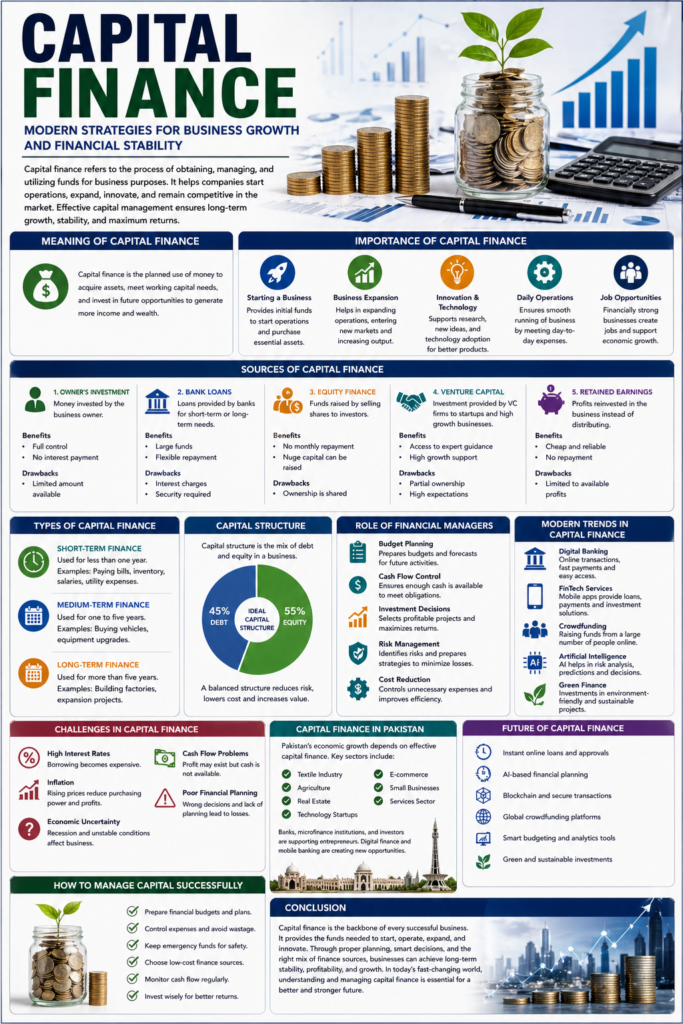
Capital Finance: Modern Strategies for Business Growth and Financial Stability

Cover Image


Introduction

Capital finance is one of the most important elements of business success. Every organization, whether a small startup or a multinational company, requires money to begin operations, grow, and remain competitive. The funds used for purchasing assets, paying employees, expanding production, and investing in new opportunities are known as capital. Managing these funds wisely is called capital finance.

In the modern business world, capital finance has become more advanced than ever before. Businesses now use traditional loans, stock markets, venture capital, crowdfunding, and digital banking systems to raise funds. A company with strong financial planning can survive challenges, grow rapidly, and achieve long-term success.

This article explains the meaning, importance, sources, types, challenges, and future of capital finance in detail.


Meaning of Capital Finance

Capital finance refers to the process of obtaining, managing, and using funds for business purposes. It includes both short-term money for daily operations and long-term money for expansion and investment.

The word capital means wealth or resources used to generate more wealth. Finance means the management of money. Therefore, capital finance is the planned use of money to support business growth.

Examples include:

  • Purchasing land for a factory
  • Buying machinery and tools
  • Hiring employees
  • Launching products
  • Opening branches in new cities

Without capital finance, businesses cannot function properly.


Importance of Capital Finance

Capital finance plays a major role in economic development and business performance.

1. Starting a Business

Every business needs initial investment to rent offices, buy equipment, and purchase stock.

2. Business Expansion

Companies need additional funds to increase production, open new stores, or enter international markets.

3. Smooth Daily Operations

Working capital helps businesses pay salaries, rent, transport, and electricity bills.

4. Innovation and Technology

Modern companies invest in research, software, automation, and product development.

5. Job Opportunities

Financially strong businesses hire more employees and support the economy.


Sources of Capital Finance

Businesses use many sources to obtain funds.

1. Owner’s Investment

Money invested by the business owner.

Benefits:

  • Full ownership remains with owner
  • No interest payments

Drawbacks:

  • Limited amount available

2. Bank Loans

Banks provide short-term and long-term loans.

Benefits:

  • Large funds available
  • Flexible repayment options

Drawbacks:

  • Interest charges
  • Security required

3. Equity Finance

Companies sell shares to investors.

Benefits:

  • No monthly repayment
  • Large capital can be raised

Drawbacks:

  • Ownership is shared

4. Venture Capital

Startups receive investment from venture capital firms.

This is common in technology businesses with high growth potential.


5. Retained Earnings

Companies reinvest profits instead of distributing them.

This is one of the cheapest sources of finance.


Types of Capital Finance

Short-Term Finance

Used for less than one year.

Examples:

  • Paying utility bills
  • Buying inventory
  • Salaries

Medium-Term Finance

Used for one to five years.

Examples:

  • Buying vehicles
  • Equipment upgrades

Long-Term Finance

Used for more than five years.

Examples:

  • Factory construction
  • Major expansion projects

Capital Structure

Capital structure means the mix of debt and equity used by a business.

A balanced structure is important because:

  • Too much debt creates repayment pressure
  • Too much equity reduces owner control

Good companies maintain a smart balance between both.

For example:

  • 55% Equity
  • 45% Debt

This helps reduce risk and increase returns.


Role of Financial Managers

Financial managers are responsible for effective capital management.

Their duties include:

Budget Planning

Preparing financial plans for future needs.

Cash Flow Control

Ensuring enough cash is available.

Investment Decisions

Selecting profitable business opportunities.

Risk Management

Reducing losses caused by uncertainty.

Cost Reduction

Controlling wasteful spending.


Modern Trends in Capital Finance

Capital finance is changing rapidly because of technology.

1. Digital Banking

Online banking allows quick transfers and easy payments.

2. FinTech Services

Apps offer loans, mobile wallets, and investment tools.

3. Crowdfunding

Businesses collect small investments from many people online.

4. Artificial Intelligence

AI helps analyze risks and predict financial performance.

5. Green Finance

Funds are invested in eco-friendly projects.


Challenges in Capital Finance

Many businesses face financial difficulties.

1. High Interest Rates

Borrowing money becomes expensive.

2. Inflation

Prices rise and reduce profits.

3. Economic Uncertainty

Recession affects demand and investment.

4. Cash Flow Problems

Businesses may have profit but not enough cash.

5. Poor Financial Planning

Bad decisions can cause losses and failure.


Capital Finance in Pakistan

Capital finance is growing in Pakistan.

Important sectors include:

  • Textile industry
  • Agriculture
  • Real estate
  • Technology startups
  • E-commerce
  • Small businesses

Banks, microfinance institutions, and investors are supporting entrepreneurship.

Digital payment systems are also increasing rapidly.


Future of Capital Finance

The future of capital finance is modern and technology-based.

Expected developments include:

  • Instant online loans
  • AI-based financial planning
  • Blockchain transactions
  • Global crowdfunding platforms
  • Smart budgeting software
  • Sustainable green investments

Businesses using these systems will grow faster.


How to Manage Capital Successfully

To manage finance properly, businesses should:

  • Prepare financial budgets
  • Control unnecessary expenses
  • Keep emergency reserves
  • Choose low-cost finance sources
  • Monitor cash flow regularly
  • Invest carefully

Conclusion

Capital finance is the backbone of every successful business. It provides the money required to start, operate, expand, and innovate. Through loans, equity investment, retained earnings, and modern financial technology, companies can achieve their goals.

In the modern world, understanding capital finance is essential for business owners, managers, and investors. Strong financial planning leads to stability, profitability, and long-term growth.

Capital finance will continue to shape the future of business and economic progress.

Capital Finance

Introduction

Capital finance is one of the most important parts of modern business and economics. It refers to the funds or money that businesses, organizations, and governments use for starting, operating, and expanding their activities. Every business, whether small or large, needs capital to purchase machinery, hire workers, produce goods, and grow in the market. Without proper finance, no company can survive for a long time.

Capital finance plays a major role in economic development because it helps industries expand, creates employment opportunities, and increases production. Large financial institutions such as JPMorgan Chase and Goldman Sachs are examples of organizations involved in capital finance worldwide.


Meaning of Capital Finance

Capital finance means raising money for long-term and short-term business needs. It is the money used to purchase fixed assets like land, buildings, machinery, and technology. It is also used for working capital, which includes day-to-day expenses such as salaries, rent, and raw materials.

For example, if a company wants to build a new factory, open a branch office, or introduce a new product, it needs a large amount of money. This money is arranged through capital finance.


Types of Capital Finance

1. Equity Finance

Equity finance is the money raised by selling shares of the company to investors. People who buy shares become part owners of the company. They receive profits in the form of dividends and benefit when the company grows.

Large companies such as Apple Inc. and Tesla have raised huge amounts of money through equity finance.

2. Debt Finance

Debt finance means borrowing money from banks or other lenders. The company must repay the loan with interest. It is one of the most common methods of financing businesses.

3. Venture Capital

Venture capital is investment provided to new startup businesses that have high growth potential. Investors provide funds in exchange for ownership shares.

Sequoia Capital is a famous venture capital company.

4. Retained Earnings

Retained earnings are profits that a company keeps and reinvests in the business instead of distributing to shareholders.


Importance of Capital Finance

1. Starting a Business

No business can begin without money. Capital is needed for registration, office setup, purchasing equipment, and marketing.

2. Expansion of Business

When a business wants to grow, open new branches, or increase production, it requires additional finance.

3. Employment Opportunities

When companies receive capital, they hire more workers, which reduces unemployment.

4. Economic Growth

Capital finance increases industrial production, exports, and tax revenue, which supports national economic development.


Sources of Capital Finance

Banks

Banks provide loans and financial support to businesses.

Habib Bank Limited
Meezan Bank

Stock Market

Companies can raise money by issuing shares in stock markets.

Pakistan Stock Exchange

Bonds

Governments and companies issue bonds to borrow money from investors.

Private Investors

Individuals and institutions may invest money in profitable businesses.


Advantages of Capital Finance

  1. Helps businesses grow quickly
  2. Allows purchase of modern technology
  3. Increases production capacity
  4. Creates more jobs
  5. Improves profits and market value

Disadvantages of Capital Finance

  1. Loans require interest payments
  2. Selling shares reduces ownership control
  3. Too much debt can create financial risk
  4. Investors may influence business decisions

Capital Finance in Pakistan

Capital finance is growing in Pakistan through banks, stock markets, and Islamic finance systems. The government also provides business loans for youth and small enterprises.

State Bank of Pakistan manages the country’s banking and financial system.


Modern Trends in Capital Finance

Today, technology has changed the financial sector. Online banking, digital payments, and crowdfunding are modern forms of finance.

PayPal
Stripe

These companies have made financial transactions faster and easier.


Risks in Capital Finance

  1. Market losses
  2. Rising interest rates
  3. Economic recession
  4. Business failure
  5. Inability to repay loans

Principles of Good Capital Finance

  1. Proper planning
  2. Balanced use of debt and equity
  3. Low-cost financing
  4. Risk management
  5. Wise use of profits

Conclusion

Capital finance is the backbone of every successful business and economy. It provides the money needed to start, operate, and expand businesses. Without capital finance, industries cannot grow and economies cannot progress. Proper use of finance leads to business success, job creation, and national prosperity.

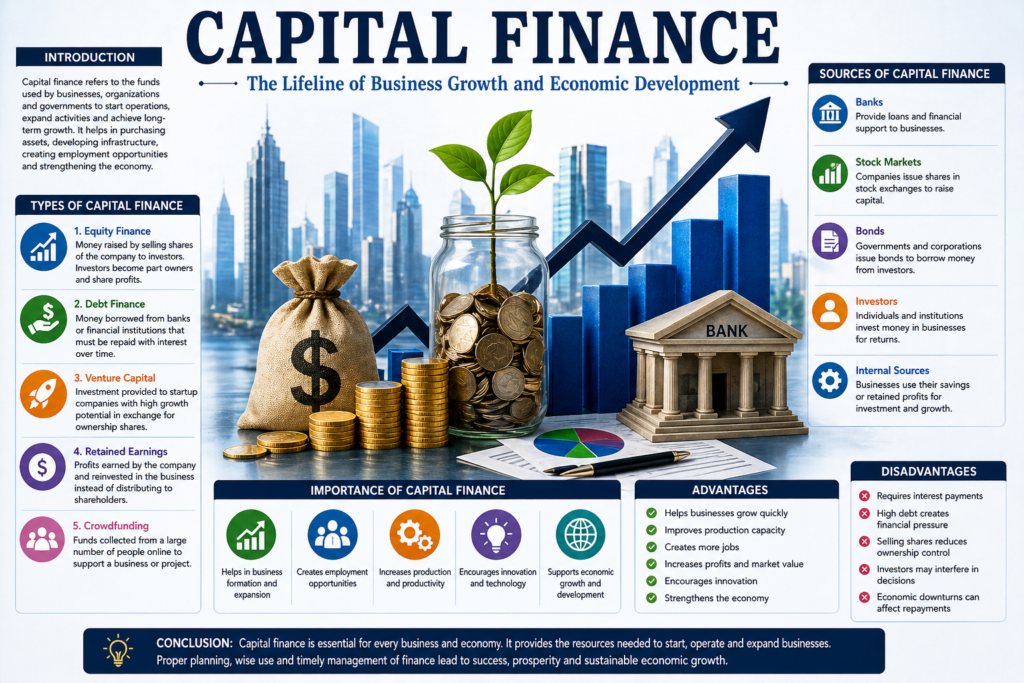
Capital Finance: Importance, Sources, Types, and Role in Economic Growth

Introduction

Capital finance is one of the most essential elements of every business and economy. It refers to the money or funds used by businesses, organizations, and governments to start operations, purchase assets, expand activities, and meet financial needs. Without sufficient capital, no business can survive or grow in a competitive market.

Every company, whether small or large, needs money for purchasing machinery, hiring employees, buying raw materials, marketing products, and expanding operations. Capital finance helps companies fulfill these needs through different financial sources such as loans, shares, bonds, and retained profits.

In the modern world, capital finance has become the backbone of industrial growth and economic development. Financial institutions such as JPMorgan Chase, Goldman Sachs, and HSBC play a major role in providing capital worldwide.


Meaning of Capital Finance

Capital finance means arranging money for long-term and short-term business purposes. It includes the funds used for fixed assets like buildings, land, vehicles, and machinery, as well as working capital used for daily expenses such as wages, rent, electricity bills, and purchasing stock.

For example, if a company wants to build a new factory, open branches in new cities, or introduce a new product in the market, it needs financial resources. These resources are obtained through capital finance.

Capital finance is important because businesses cannot function properly without investment. Even profitable businesses often need additional funds to expand faster.


Types of Capital Finance

1. Equity Finance

Equity finance is the money raised by selling shares of the company to investors. Investors become part owners of the business and share profits through dividends.

Companies such as Apple Inc. and Tesla have raised billions through stock markets.

2. Debt Finance

Debt finance means borrowing money from banks, financial institutions, or lenders. The business must repay the loan with interest over time.

This method is common among small and medium businesses.

3. Venture Capital

Venture capital is investment given to startup companies with high growth potential. Investors provide money in return for ownership shares.

Sequoia Capital is a famous example of a venture capital company.

4. Retained Earnings

Retained earnings are profits that a company keeps instead of distributing among shareholders. These profits are reinvested in the business for growth.

5. Crowdfunding

Crowdfunding is a modern method where many people contribute small amounts of money online to support a business or project.


Importance of Capital Finance

1. Business Formation

Every business begins with capital. Money is needed for registration, equipment, office setup, and purchasing materials.

2. Business Expansion

To grow operations, businesses need extra capital for opening branches, buying advanced technology, and increasing production.

3. Employment Creation

When businesses expand through capital finance, they hire more workers, reducing unemployment.

4. Economic Growth

Capital finance increases production, exports, industrial activity, and tax revenue, helping the country’s economy grow.

5. Innovation and Technology

Finance helps businesses invest in research, technology, and innovation.


Sources of Capital Finance

Banks

Banks are one of the most common sources of finance. They provide loans to businesses and individuals.

Habib Bank Limited
Meezan Bank

Stock Markets

Companies issue shares to raise funds through stock exchanges.

Pakistan Stock Exchange

Bonds

Governments and corporations issue bonds to borrow money from investors for long-term needs.

Investors

Private investors often provide funds to profitable or growing businesses.

Internal Sources

Businesses may use savings or retained profits for investment.


Advantages of Capital Finance

  1. Helps businesses grow quickly
  2. Improves production capacity
  3. Supports purchase of modern machinery
  4. Creates employment opportunities
  5. Increases profits and market value
  6. Encourages innovation
  7. Strengthens economic development

Disadvantages of Capital Finance

  1. Loans require interest payments
  2. High debt creates financial pressure
  3. Selling shares reduces ownership control
  4. Investors may interfere in decisions
  5. Poor planning can lead to losses
  6. Economic downturns can affect repayment ability

Capital Finance in Pakistan

Capital finance is growing rapidly in Pakistan. Banks, Islamic finance institutions, stock markets, and government programs are supporting businesses. Small and medium enterprises (SMEs) are receiving loans for expansion and job creation.

State Bank of Pakistan regulates the banking sector and maintains monetary stability.

Youth loan schemes and startup funding programs are also helping new entrepreneurs.


Modern Trends in Capital Finance

Technology has changed the financial world. Digital banking, online lending, and mobile payments are making finance easier and faster.

PayPal
Stripe

These companies allow businesses to receive payments and manage funds globally.

Cryptocurrency and blockchain technology are also changing the future of finance, although they involve risks.


Risks in Capital Finance

  1. Rising interest rates
  2. Inflation
  3. Market competition
  4. Business failure
  5. Poor management decisions
  6. Economic recession
  7. Delayed repayments

Businesses must manage these risks carefully through planning and budgeting.


Principles of Good Capital Finance

  1. Proper financial planning
  2. Balance between debt and equity
  3. Low-cost financing methods
  4. Timely repayment of loans
  5. Risk management
  6. Wise reinvestment of profits
  7. Strong accounting systems

Conclusion

Capital finance is the foundation of business success and economic growth. It provides the money needed to start, operate, and expand businesses. Without proper finance, industries cannot grow and employment opportunities remain limited.

From small startups to multinational corporations, every business depends on capital finance in some form. If managed wisely, capital finance increases productivity, profits, and national prosperity. Therefore, it is considered one of the most important parts of modern economics and business management.

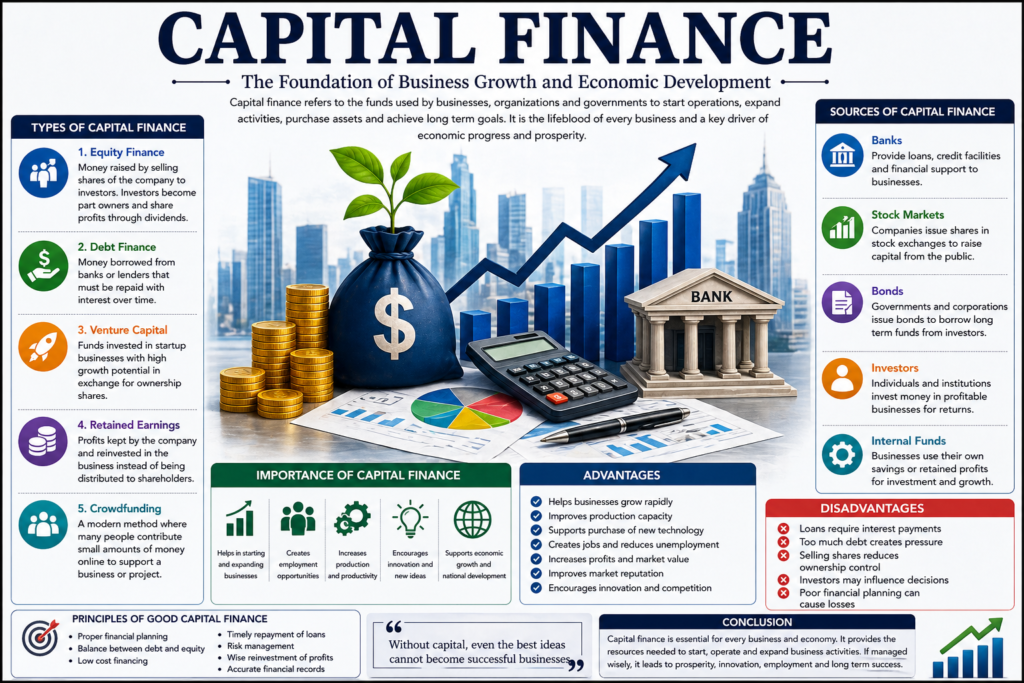
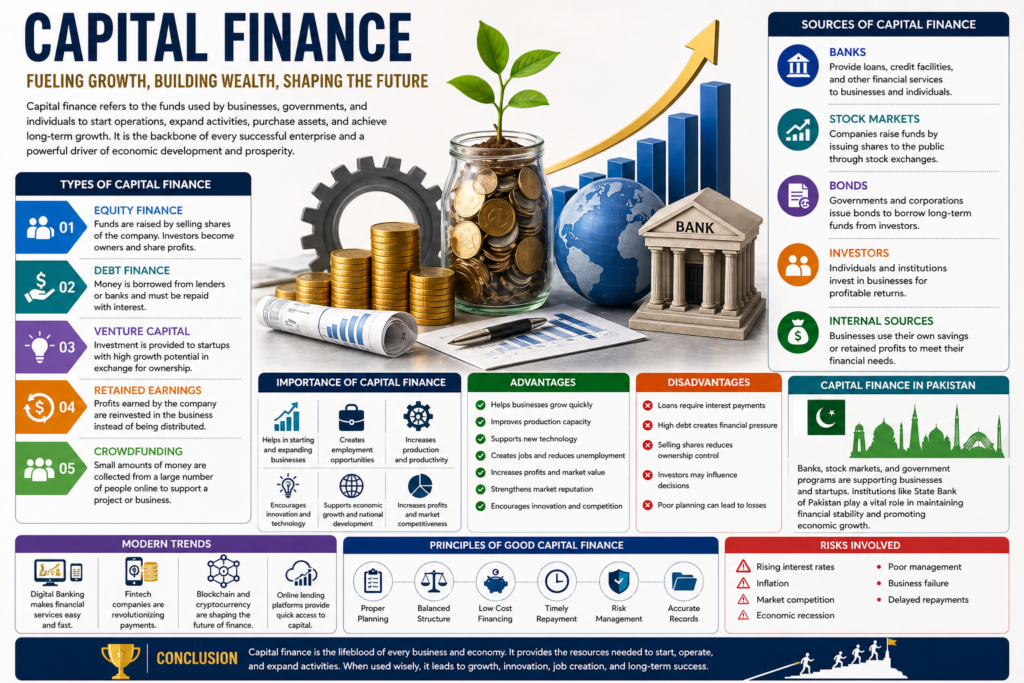
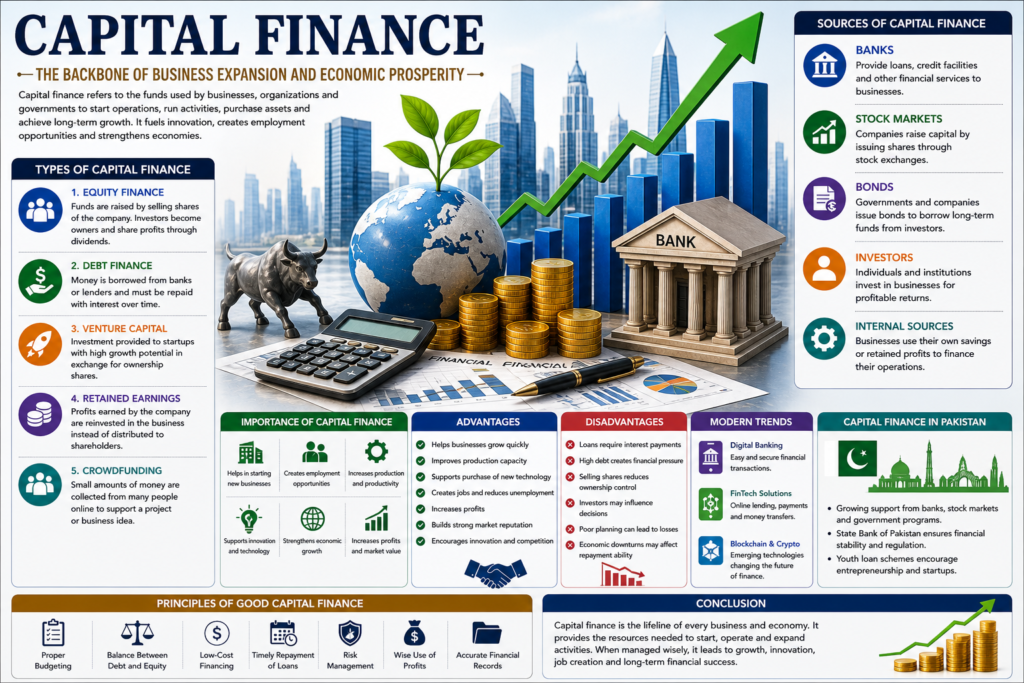
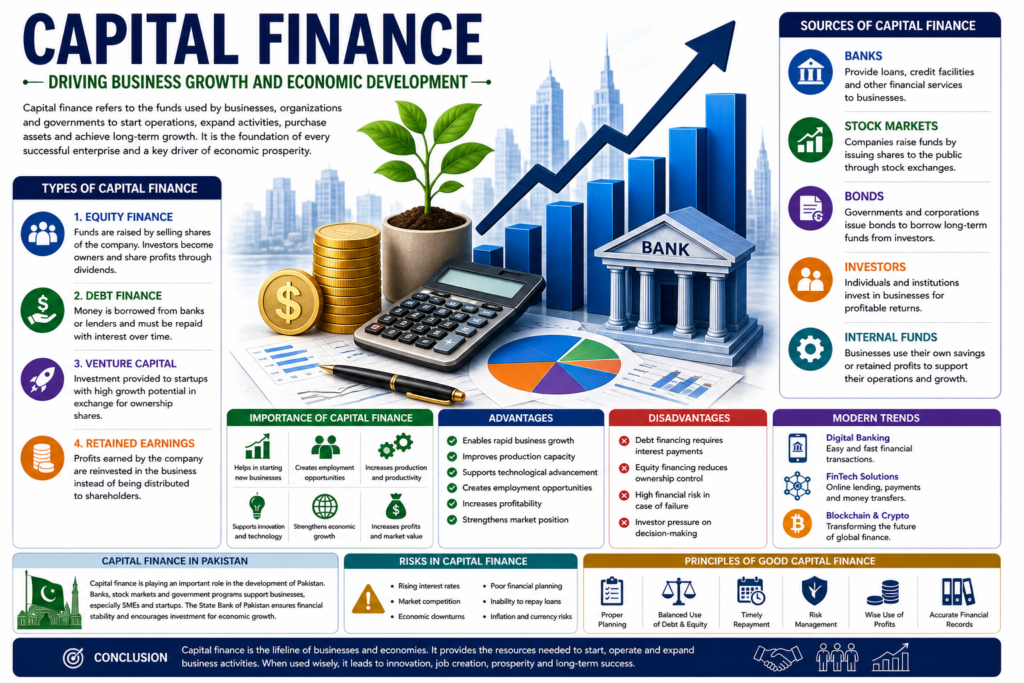
Capital Finance: The Foundation of Business Growth and Economic Development

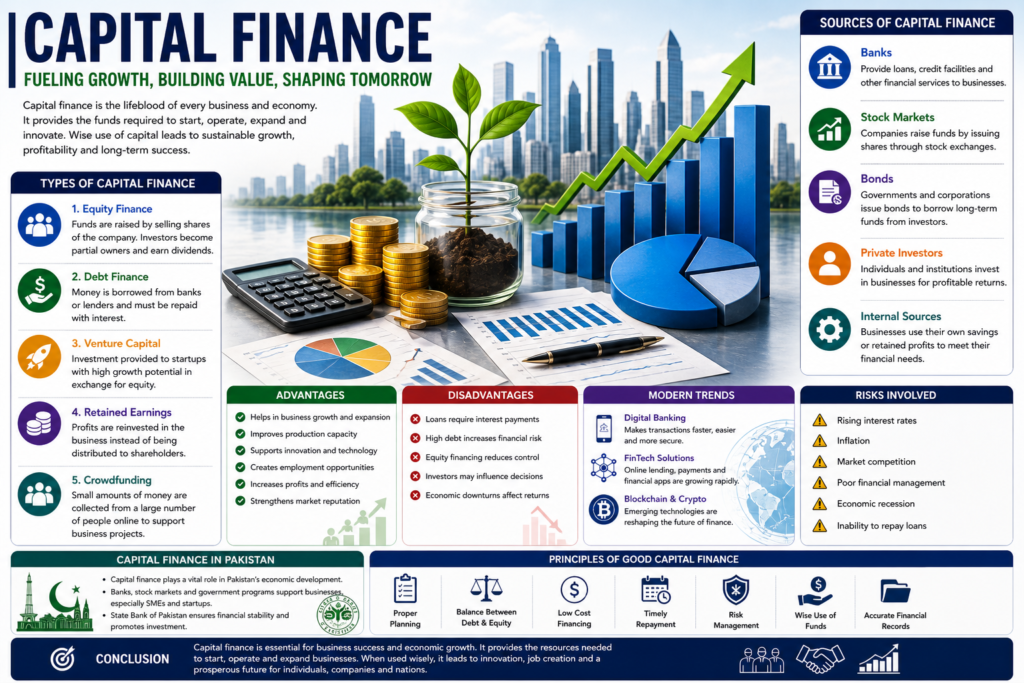
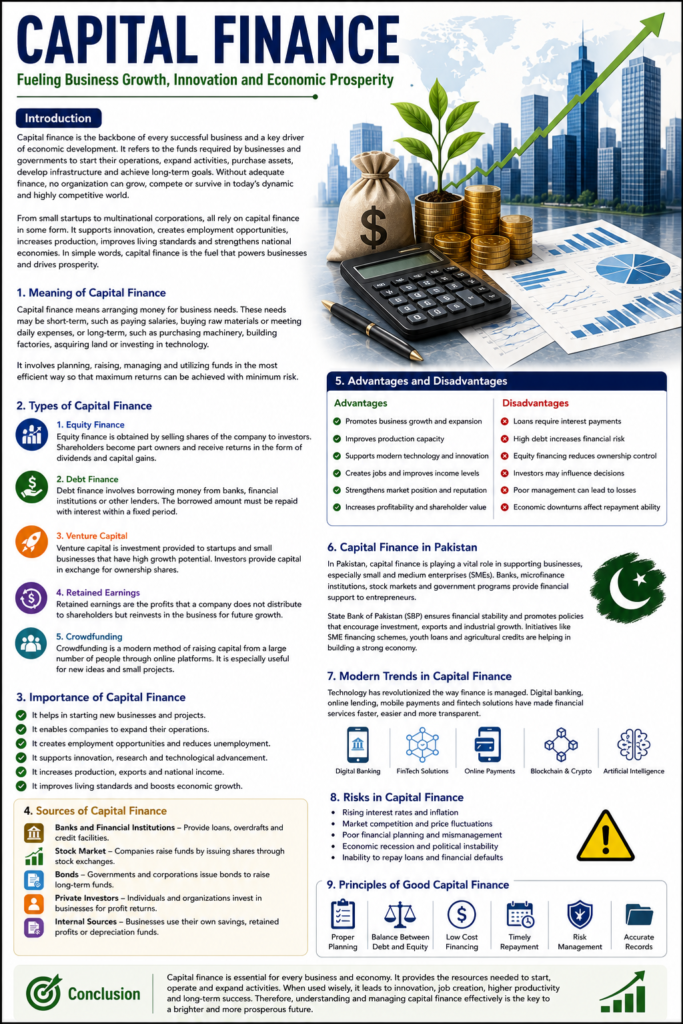
Introduction

Capital finance is one of the most important aspects of business management and economic progress. It refers to the money or funds required by businesses, industries, and governments to start operations, manage daily activities, purchase assets, and expand in the future. Every organization, whether small or large, needs capital to survive and succeed in today’s competitive world.

Without finance, no company can buy machinery, hire workers, produce goods, or provide services. Capital finance supports innovation, productivity, and job creation. It is often called the backbone of modern business because it enables companies to turn ideas into successful enterprises.

Large financial institutions such as JPMorgan Chase, HSBC, and Goldman Sachs play an important role in providing capital around the world.


Meaning of Capital Finance

Capital finance means arranging money for long-term and short-term business needs. Long-term finance is used for purchasing land, buildings, vehicles, and machinery. Short-term finance is used for daily expenses such as salaries, electricity bills, rent, transportation, and raw materials.

For example, if a company wants to open a new branch, buy advanced machines, or launch a new product, it requires money. This money is obtained through capital finance.

Finance is necessary not only for starting a business but also for maintaining and expanding it over time.


Types of Capital Finance

1. Equity Finance

Equity finance means raising money by selling shares of a company to investors. In return, investors become part owners and share profits through dividends.

Well-known companies such as Apple Inc. and Tesla have raised large amounts of money through equity finance.

2. Debt Finance

Debt finance means borrowing money from banks or lenders. The borrowed amount must be repaid with interest over a specific period.

This is common for small and medium businesses.

3. Venture Capital

Venture capital is money invested in startup businesses that have strong growth potential. Investors receive ownership shares in return.

Sequoia Capital is a famous venture capital company.

4. Retained Earnings

Retained earnings are profits kept by a company and reinvested in business growth instead of being distributed to shareholders.

5. Crowdfunding

Crowdfunding is a modern financing method in which many people contribute small amounts of money online for a business project.


Importance of Capital Finance

1. Starting a Business

Every business needs money to begin. Funds are required for registration, office rent, furniture, machinery, and advertising.

2. Business Expansion

When a business wants to grow, it needs extra capital to open branches, increase production, and improve quality.

3. Employment Opportunities

Businesses that receive finance hire more workers, reducing unemployment.

4. Economic Development

Capital finance increases industrial production, exports, and tax revenue, which helps national development.

5. Innovation

Finance enables businesses to invest in new ideas, research, and technology.


Sources of Capital Finance

Banks

Banks are a major source of finance. They provide loans and business support.

Habib Bank Limited
Meezan Bank

Stock Markets

Companies can issue shares through stock exchanges to raise capital.

Pakistan Stock Exchange

Bonds

Governments and companies issue bonds to borrow funds from investors.

Investors

Private investors and institutions often invest in profitable businesses.

Internal Funds

Businesses may use their own savings or retained profits.


Advantages of Capital Finance

  1. Helps businesses grow rapidly
  2. Improves production capacity
  3. Supports purchase of new technology
  4. Creates jobs
  5. Increases profits
  6. Improves market reputation
  7. Encourages innovation

Disadvantages of Capital Finance

  1. Loans require interest payments
  2. Too much debt creates pressure
  3. Selling shares reduces ownership control
  4. Investors may influence decisions
  5. Poor financial planning can cause losses

Capital Finance in Pakistan

Capital finance is expanding in Pakistan through banks, stock markets, and Islamic finance institutions. Small and medium enterprises are receiving support through business loan programs.

State Bank of Pakistan controls the banking system and monetary policy of the country.

Government programs for youth entrepreneurship are also encouraging startups.


Modern Trends in Capital Finance

Technology has transformed the financial world. Digital banking, mobile payments, and online lending have made finance faster and easier.

PayPal
Stripe

These companies help businesses manage payments worldwide.

Blockchain and cryptocurrency are also emerging financial trends.


Risks in Capital Finance

  1. Rising interest rates
  2. Inflation
  3. Market competition
  4. Poor management
  5. Economic recession
  6. Business failure
  7. Delayed loan repayments

Proper planning is necessary to manage these risks.


Principles of Good Capital Finance

  1. Proper budgeting
  2. Balance between debt and equity
  3. Low-cost financing
  4. Timely repayment of loans
  5. Risk management
  6. Wise reinvestment of profits
  7. Accurate financial records

Conclusion

Capital finance is the foundation of every successful business and strong economy. It provides the money required to start, operate, and expand business activities. Without capital finance, industries cannot grow, jobs cannot be created, and economies cannot progress.

From small startups to multinational corporations, all organizations depend on finance. If managed wisely, capital finance leads to prosperity, innovation, employment, and long-term success. Therefore, it remains one of the most important pillars of modern business and economic development.

Capital Finance: A Key to Business Success and Economic Growth

Introduction

Capital finance is one of the most important concepts in the world of business and economics. It refers to the money or funds that businesses, industries, and governments use to start operations, run activities, buy assets, and expand in the future. Without sufficient capital, no business can survive or grow successfully. Every organization needs money to purchase machinery, hire employees, buy raw materials, and market its products.

Capital finance plays a significant role in increasing production, creating jobs, and improving the standard of living in society. It is considered the backbone of every successful business because it transforms ideas into profitable enterprises. Financial institutions such as JPMorgan Chase, HSBC, and Goldman Sachs are major providers of finance around the world.


Meaning of Capital Finance

Capital finance means obtaining money for both long-term and short-term business needs. Long-term finance is required for purchasing fixed assets such as land, buildings, machinery, vehicles, and technology. Short-term finance is needed for daily business expenses such as salaries, rent, electricity bills, transportation, and raw materials.

For example, if a company wants to establish a new factory, open branches in other cities, or introduce a new product, it needs large financial resources. These resources are arranged through capital finance.

Capital finance is necessary not only to start a business but also to maintain its operations and support future expansion.


Types of Capital Finance

1. Equity Finance

Equity finance means raising funds by selling shares of the company to investors. In return, investors become part owners and receive a share of profits through dividends.

Famous companies such as Apple Inc. and Tesla have raised billions through equity finance.

2. Debt Finance

Debt finance means borrowing money from banks, lenders, or financial institutions. The borrowed money must be repaid with interest over a fixed period.

This method is popular among businesses that need immediate funds.

3. Venture Capital

Venture capital is investment provided to startup companies with strong growth potential. Investors receive ownership shares in return.

Sequoia Capital is a well-known venture capital company.

4. Retained Earnings

Retained earnings are profits kept by the company and reinvested in business growth instead of being distributed among shareholders.

5. Crowdfunding

Crowdfunding is a modern financing method in which many people contribute small amounts of money online to support a project or business idea.


Importance of Capital Finance

1. Starting a Business

Every business needs capital at the beginning for office setup, equipment, registration, and advertising.

2. Business Expansion

When a business wants to increase production, open branches, or improve quality, it requires additional funds.

3. Employment Opportunities

When businesses receive finance, they hire more employees, which reduces unemployment.

4. Economic Growth

Capital finance increases industrial production, exports, and tax revenue, helping the national economy grow.

5. Innovation and Development

Businesses use finance to invest in research, technology, and new ideas.


Sources of Capital Finance

Banks

Banks are one of the main sources of business finance. They provide loans and financial services.

Habib Bank Limited
Meezan Bank

Stock Markets

Companies can issue shares through stock exchanges to raise capital.

Pakistan Stock Exchange

Bonds

Governments and companies issue bonds to borrow long-term funds from investors.

Investors

Private investors often invest in profitable businesses for returns.

Internal Funds

Businesses may use their own savings or retained profits.


Advantages of Capital Finance

  1. Helps businesses grow quickly
  2. Supports purchase of modern machinery
  3. Improves production capacity
  4. Creates job opportunities
  5. Increases profits
  6. Builds strong market reputation
  7. Encourages innovation

Disadvantages of Capital Finance

  1. Loans require interest payments
  2. Too much debt creates pressure
  3. Selling shares reduces ownership control
  4. Investors may influence management decisions
  5. Poor planning can lead to losses

Capital Finance in Pakistan

Capital finance is developing rapidly in Pakistan through commercial banks, Islamic banking systems, stock markets, and government support programs. Small and medium enterprises are receiving loans for growth and expansion.

State Bank of Pakistan regulates the financial system of the country.

Government youth loan schemes are helping new entrepreneurs establish businesses.


Modern Trends in Capital Finance

Technology has transformed financial systems worldwide. Online banking, mobile payments, and digital lending have made financial services easier and faster.

PayPal
Stripe

These companies allow businesses to manage payments globally.

Cryptocurrency and blockchain are also modern financial innovations.


Risks in Capital Finance

  1. Rising interest rates
  2. Inflation
  3. Market competition
  4. Poor management decisions
  5. Economic recession
  6. Business failure
  7. Delayed repayments

These risks can be reduced through careful planning and proper management.


Principles of Good Capital Finance

  1. Proper budgeting
  2. Balance between debt and equity
  3. Low-cost financing methods
  4. Timely repayment of loans
  5. Risk management
  6. Wise use of profits
  7. Accurate financial records

Conclusion

Capital finance is the foundation of every successful business and growing economy. It provides the money needed to start, operate, and expand business activities. Without finance, industries cannot develop and employment opportunities remain limited.

From startups to multinational companies, every business depends on capital finance. If managed wisely, it leads to innovation, prosperity, job creation, and long-term success. Therefore, capital finance remains one of the most important pillars of modern business and economic progress.

Capital Finance: The Engine of Business Growth and Financial Stability

Introduction

Capital finance is one of the most important elements of modern business and economics. It refers to the money or funds that businesses, industries, and governments use to start operations, run daily activities, purchase assets, and expand in the future. Every business, whether small or large, needs capital to survive and succeed in a competitive market. Without finance, no company can buy machinery, hire workers, produce goods, or provide services.

Capital finance helps organizations turn ideas into successful enterprises. It supports industrial growth, creates employment opportunities, increases productivity, and strengthens national economies. Because of its importance, capital finance is often called the engine of business growth. Major institutions such as JPMorgan Chase, HSBC, and Goldman Sachs play a leading role in providing financial resources worldwide.


Meaning of Capital Finance

Capital finance means obtaining money for long-term and short-term business purposes. Long-term finance is required for purchasing land, buildings, machinery, vehicles, and advanced technology. Short-term finance is used for day-to-day business expenses such as salaries, electricity bills, rent, transportation, and raw materials.

For example, if a company plans to open a new branch, establish a factory, or launch a new product, it needs a large amount of money. These funds are arranged through capital finance.

Capital finance is necessary not only for starting a business but also for maintaining smooth operations and supporting future growth.


Types of Capital Finance

1. Equity Finance

Equity finance means raising funds by selling shares of the company to investors. Investors become part owners of the business and receive profits in the form of dividends.

Large corporations such as Apple Inc. and Tesla have raised billions through equity finance.

2. Debt Finance

Debt finance means borrowing money from banks or lenders. The borrowed amount must be repaid with interest within a fixed period.

This method is common among businesses that need quick funds.

3. Venture Capital

Venture capital is investment provided to startup companies with high growth potential. Investors provide money in exchange for ownership shares.

Sequoia Capital is a well-known venture capital company.

4. Retained Earnings

Retained earnings are profits kept by a company and reinvested in business development rather than distributed among shareholders.

5. Crowdfunding

Crowdfunding is a modern financing method in which many people contribute small amounts of money online to support business ideas and projects.


Importance of Capital Finance

1. Starting a Business

Every business requires money at the beginning for office setup, machinery, furniture, registration, and advertising.

2. Business Expansion

Businesses need additional funds to open branches, improve technology, and increase production.

3. Employment Opportunities

When businesses receive capital, they hire more workers, reducing unemployment.

4. Economic Growth

Capital finance increases industrial production, exports, and tax revenues, helping national development.

5. Innovation

Finance allows companies to invest in research, development, and new technologies.


Sources of Capital Finance

Banks

Banks are one of the most common sources of finance. They provide loans, overdrafts, and business support.

Habib Bank Limited
Meezan Bank

Stock Markets

Companies raise money by issuing shares through stock exchanges.

Pakistan Stock Exchange

Bonds

Governments and companies issue bonds to borrow long-term funds from investors.

Private Investors

Individuals and institutions invest in profitable businesses for returns.

Internal Sources

Businesses may use their own savings or retained profits.


Advantages of Capital Finance

  1. Helps businesses grow rapidly
  2. Improves production capacity
  3. Supports purchase of new technology
  4. Creates employment opportunities
  5. Increases profits
  6. Builds strong market reputation
  7. Encourages innovation and competition

Disadvantages of Capital Finance

  1. Loans require interest payments
  2. Too much debt creates pressure
  3. Selling shares reduces ownership control
  4. Investors may influence decisions
  5. Poor financial planning can cause losses
  6. Economic downturns may affect repayment ability

Capital Finance in Pakistan

Capital finance is growing in Pakistan through commercial banks, Islamic banking, stock markets, and government schemes. Small and medium enterprises are receiving loans to expand businesses and create jobs.

State Bank of Pakistan regulates the banking system and ensures financial stability.

Youth entrepreneurship programs are also helping new business owners.


Modern Trends in Capital Finance

Technology has transformed financial systems around the world. Online banking, mobile wallets, and digital lending have made finance easier and faster.

PayPal
Stripe

These companies help businesses receive payments globally.

Cryptocurrency, blockchain, and fintech startups are also changing the future of finance.


Risks in Capital Finance

  1. Rising interest rates
  2. Inflation
  3. Market competition
  4. Poor management decisions
  5. Economic recession
  6. Business failure
  7. Delayed loan repayments

Proper planning and budgeting help reduce these risks.


Principles of Good Capital Finance

  1. Proper budgeting
  2. Balance between debt and equity
  3. Low-cost financing methods
  4. Timely repayment of loans
  5. Risk management
  6. Wise reinvestment of profits
  7. Accurate financial records

Conclusion

Capital finance is the foundation of every successful business and strong economy. It provides the money needed to start, operate, and expand business activities. Without proper finance, industries cannot grow, jobs cannot be created, and economies cannot progress.

From small startups to multinational corporations, all organizations depend on finance. If managed wisely, capital finance leads to innovation, prosperity, employment, and long-term success. Therefore, it remains one of the most important pillars of modern business and economic development.


Capital Finance: The Backbone of Business Expansion and Economic Prosperity

Introduction

Capital finance is one of the most essential concepts in the world of commerce, business, and economics. It refers to the money or funds used by businesses, industries, and governments to start operations, run daily activities, buy assets, and expand in the future. Every successful business needs sufficient capital to survive in the market and compete effectively. Without finance, companies cannot purchase machinery, hire employees, produce goods, or provide services.

Capital finance is often described as the backbone of business growth because it provides the financial strength needed for progress. It helps companies turn innovative ideas into profitable enterprises, creates employment opportunities, and improves national economic development. Many global institutions such as JPMorgan Chase, HSBC, and Goldman Sachs play an important role in providing capital across the world.


Meaning of Capital Finance

Capital finance means arranging money for both long-term and short-term business purposes. Long-term finance is needed for purchasing land, buildings, machinery, technology, and vehicles. Short-term finance is used for daily expenses such as salaries, rent, electricity bills, transportation, and raw materials.

For example, if a company wants to establish a new factory, open branches in different cities, or launch a new product, it needs a large amount of money. This money is obtained through capital finance.

Finance is not only necessary for starting a business but also for maintaining regular operations and supporting future expansion.


Types of Capital Finance

1. Equity Finance

Equity finance means raising funds by selling shares of a company to investors. Investors become part owners of the business and receive profits through dividends.

Well-known corporations such as Apple Inc. and Tesla have raised billions through equity markets.

2. Debt Finance

Debt finance means borrowing money from banks or lenders. The borrowed amount must be repaid with interest over time.

This is one of the most common financing methods for businesses.

3. Venture Capital

Venture capital is investment provided to startup companies with high growth potential. Investors receive ownership shares in return.

Sequoia Capital is a leading venture capital company.

4. Retained Earnings

Retained earnings are profits kept by the company and reinvested in future growth rather than distributed among shareholders.

5. Crowdfunding

Crowdfunding is a modern financing method where many people contribute small amounts of money online to support projects or businesses.


Importance of Capital Finance

1. Starting a Business

Every business needs money at the beginning for registration, office setup, machinery, furniture, and advertising.

2. Business Expansion

Businesses need additional funds to increase production, open branches, and improve quality.

3. Employment Creation

When businesses grow with capital finance, they hire more workers and reduce unemployment.

4. Economic Growth

Capital finance increases industrial production, exports, and tax revenue, helping the economy develop.

5. Innovation and Research

Finance allows companies to invest in technology, research, and new product development.


Sources of Capital Finance

Banks

Banks are one of the most common sources of finance. They provide loans, credit facilities, and financial support.

Habib Bank Limited
Meezan Bank

Stock Markets

Companies raise money by issuing shares through stock exchanges.

Pakistan Stock Exchange

Bonds

Governments and companies issue bonds to borrow long-term funds from investors.

Investors

Private investors and institutions invest in businesses for profit returns.

Internal Funds

Businesses may use their own savings or retained profits.


Advantages of Capital Finance

  1. Helps businesses grow quickly
  2. Supports purchase of modern machinery
  3. Improves production capacity
  4. Creates job opportunities
  5. Increases profits
  6. Builds strong market reputation
  7. Encourages innovation

Disadvantages of Capital Finance

  1. Loans require interest payments
  2. Too much debt creates pressure
  3. Selling shares reduces ownership control
  4. Investors may influence decisions
  5. Poor planning can cause losses
  6. Economic crises may affect repayment ability

Capital Finance in Pakistan

Capital finance is developing rapidly in Pakistan through banks, Islamic financial institutions, stock markets, and government programs. Small and medium enterprises are receiving loans to expand operations.

State Bank of Pakistan regulates the financial system and maintains stability.

Government youth loan programs are helping entrepreneurs start new businesses.


Modern Trends in Capital Finance

Technology has transformed financial systems worldwide. Digital banking, online lending, and mobile payments have made finance easier and faster.

PayPal
Stripe

These companies help businesses receive payments globally.

Cryptocurrency, blockchain, and fintech startups are also influencing the future of finance.


Risks in Capital Finance

  1. Rising interest rates
  2. Inflation
  3. Market competition
  4. Poor management
  5. Economic recession
  6. Business failure
  7. Delayed repayments

These risks can be controlled through wise planning and effective management.


Principles of Good Capital Finance

  1. Proper budgeting
  2. Balance between debt and equity
  3. Low-cost financing
  4. Timely repayment of loans
  5. Risk management
  6. Wise reinvestment of profits
  7. Accurate financial records

Conclusion

Capital finance is the foundation of every successful business and growing economy. It provides the money needed to start, operate, and expand business activities. Without finance, industries cannot grow, jobs cannot be created, and economies cannot progress.

From small startups to multinational corporations, all businesses depend on capital finance. If managed wisely, it leads to prosperity, innovation, employment, and long-term success. Therefore, capital finance remains one of the most important pillars of modern business and economic development.


📝 Title: Capital Finance: A Complete and Practical Guide for Beginners

📌 Introduction

Capital finance ek business ki backbone hoti hai. Har company, chahe choti ho ya bari, apni growth aur stability ke liye finance par depend karti hai. Agar kisi business ke paas proper capital na ho, to wo survive nahi kar sakta.

Simple words mein, capital finance ka matlab hai paise ko manage karna, invest karna aur profit generate karna.


💡 What is Capital Finance?

Capital finance wo process hai jisme businesses funds raise karte hain aur unhein efficiently use karte hain.

Iska use hota hai:

  • New business start karne ke liye
  • Business expand karne ke liye
  • Machinery aur equipment kharidne ke liye
  • Daily expenses manage karne ke liye

🔍 Types of Capital Finance

1. Equity Financing

Isme company apne shares sell karti hai investors ko.

Pros:

  • Loan wapas nahi karna hota
  • Financial pressure kam hota hai

Cons:

  • Ownership share karni parti hai
  • Profit bhi divide hota hai

2. Debt Financing

Isme business loan leta hai bank ya institution se.

Examples:

  • Bank loans
  • Business loans

Pros:

  • Full ownership rehti hai
  • Fixed terms hote hain

Cons:

  • Interest dena parta hai
  • Risk hota hai agar repayment na ho

3. Working Capital

Ye daily expenses ke liye hota hai jaise:

  • Salary
  • Rent
  • Bills

Importance of Capital Finance

Capital finance ke baghair business grow nahi kar sakta.

Key benefits:

  • Business growth fast hoti hai
  • Cash flow improve hota hai
  • Long-term planning easy hoti hai
  • Financial stability milti hai

🌍 Sources of Capital

Internal Sources

  • Personal savings
  • Business profit

External Sources

  • Banks
  • Investors
  • Venture capital

📊 Capital Budgeting

Ye process hota hai jisme business decide karta hai ke konsa investment profitable hai.

Common methods:

  • Payback period
  • NPV (Net Present Value)
  • IRR (Internal Rate of Return)

⚠️ Risk Management

Har investment mein risk hota hai, isliye planning zaroori hai.

Risk control tips:

  • Investment diversify karo
  • Emergency fund rakho
  • Proper planning karo

🚀 Role of Technology

Aaj kal technology ne finance ko easy bana diya hai:

  • Online banking
  • Finance apps
  • Automation tools

Ye sab business ko better decisions lene mein help karte hain.


Common Mistakes

  • Planning ke baghair investment
  • Zyada loan lena
  • Cash flow ignore karna
  • Research na karna

Conclusion

Capital finance ek powerful tool hai jo business ko grow karne mein help karta hai. Agar sahi planning aur strategy use ki jaye, to koi bhi business successful ban sakta hai.


🖼️ Image Idea (Use for your post)

Tum apni website ke liye ye image use kar sakte ho:

👉 Concept:

  • Ek businessman laptop par graphs dekh raha ho
  • Background mein financial charts (growth arrows 📈)
  • Coins ya money icons

👉 Free image websites:

  • Unsplash
  • Pexels

Search karo: “finance growth chart” ya “business finance concept”


💡 Bonus (SEO Tip)

  • Focus keyword: Capital Finance
  • Meta description add karo
  • Image ka ALT text likho: “Capital Finance Growth Concept”

📝 Title: Financial Planning: A Complete Guide to Secure Your Future


📝 Title: Capital Finance: A Comprehensive Guide to Business Growth and Financial Success

📌 Introduction

Capital finance kisi bhi business ki backbone hoti hai. Yeh wo system hai jo companies ko funds raise karne, investments manage karne aur long-term growth achieve karne mein madad karta hai. Aaj ke competitive business environment mein, sirf idea hona kaafi nahi hota — us idea ko successful banane ke liye strong financial planning aur capital management zaroori hoti hai.

Capital finance ka concept sirf large corporations tak limited nahi hai. Small businesses, startups aur even individuals bhi is system ka use karte hain apni financial position improve karne ke liye. Agar aap apne business ko grow karna chahte hain ya apni financial stability strong banana chahte hain, to capital finance ko samajhna bohat zaroori hai.


💡 What is Capital Finance?

Capital finance ka matlab hai funds ko raise karna aur unhein effectively manage karna taake business objectives achieve kiye ja sakein. Yeh process involve karta hai:

  • Fundraising
  • Investment planning
  • Financial risk management
  • Resource allocation

Simple words mein, capital finance ensure karta hai ke business ke paas itna paisa ho ke wo smoothly operate kar sake aur future growth ke liye invest kar sake.


🏦 Types of Capital Finance

🔹 1. Equity Financing

Equity financing mein company apne shares investors ko sell karti hai. Investors company ke partial owners ban jate hain aur profit ka hissa lete hain.

Advantages:

  • Loan repay nahi karna padta
  • Financial burden kam hota hai

Disadvantages:

  • Ownership share karni parti hai
  • Decision-making mein influence hota hai

🔹 2. Debt Financing

Debt financing mein business loan leta hai bank ya financial institution se.

Examples:

  • Bank loans
  • Bonds
  • Credit facilities

Advantages:

  • Ownership retain rehti hai
  • Tax benefits mil sakte hain

Disadvantages:

  • Interest pay karna hota hai
  • Financial risk barh jata hai

🔹 3. Working Capital Finance

Yeh short-term finance hota hai jo daily operations ke liye use hota hai:

  • Salaries
  • Rent
  • Utility bills
  • Inventory purchase

🔹 4. Venture Capital & Angel Investment

Startups ke liye yeh bohat important source hai jahan investors high-risk, high-return projects mein paisa invest karte hain.


Importance of Capital Finance

Capital finance ke bina koi bhi business sustainable nahi reh sakta. Yeh business ko structure, direction aur growth provide karta hai.

Key Benefits:

  • Business expansion mein madad
  • Cash flow management improve hota hai
  • Financial stability milti hai
  • Investment opportunities increase hoti hain
  • Risk management better hota hai

🌍 Sources of Capital Finance

🔸 Internal Sources

  • Retained earnings
  • Personal savings
  • Asset sales

🔸 External Sources

  • Banks
  • Financial institutions
  • Investors
  • Government grants
  • Crowdfunding

📊 Capital Budgeting

Capital budgeting ek critical process hai jisme businesses decide karte hain ke kaunsa project profitable hoga.

Common Techniques:

  • Payback Period
  • Net Present Value (NPV)
  • Internal Rate of Return (IRR)

Yeh methods companies ko help karte hain better investment decisions lene mein.


⚠️ Risk Management in Capital Finance

Har financial decision ke saath risk hota hai. Isliye risk management bohat zaroori hai.

Risk Types:

  • Market risk
  • Credit risk
  • Operational risk

Risk Control Strategies:

  • Diversification
  • Insurance
  • Financial planning
  • Regular monitoring

🚀 Role of Technology in Capital Finance

Modern technology ne capital finance ko revolutionize kar diya hai.

Examples:

  • Financial software
  • AI-based analytics
  • Online banking
  • Automated accounting systems

Technology ki madad se businesses better aur faster decisions le sakte hain.


📈 Capital Structure and Its Importance

Capital structure ka matlab hai ke company apne funds ko kaise divide karti hai between debt aur equity.

Balanced capital structure ke benefits:

  • Cost of capital kam hoti hai
  • Profitability increase hoti hai
  • Financial risk control hota hai

Common Mistakes in Capital Finance

  • Poor financial planning
  • Over-borrowing
  • Cash flow ignore karna
  • Investment research na karna
  • Short-term thinking

In mistakes ko avoid karke business apni success chances barha sakta hai.


🧠 Smart Strategies for Better Capital Management

  • Budgeting system follow karo
  • Regular financial analysis karo
  • Long-term planning par focus karo
  • Emergency funds maintain karo
  • Experts se advice lo

Conclusion

Capital finance ek essential tool hai jo business ko survival se success tak le jata hai. Agar aap sahi strategies use karte hain, proper planning karte hain aur risk ko manage karte hain, to aap apne financial goals easily achieve kar sakte hain.

Chahe aap ek startup founder ho ya ek established business owner, capital finance ko samajhna aur implement karna aapki long-term success ke liye bohat zaroori hai.


🖼️ Image (Horizontal – Website ke liye Ready)

👉 Use this type of image:

Concept:

  • Laptop screen par financial charts 📊
  • Coins stacks growing 📈
  • Notebook ya paper with “Capital Finance”
  • Clean office desk look

👉 Search keywords:

  • “capital finance concept”
  • “business finance growth chart laptop”
  • “investment growth coins stack”

👉 Free sites:

  • Unsplash
  • Pexels

💡 Posting Tip

  • Title ke neeche image lagao ✔
  • Phir introduction start karo ✔
  • 2nd image middle mein add karo (optional) ✔


📝 Title: Capital Finance: A Complete Guide to Managing, Investing, and Growing Business Capital

📌 Introduction

Capital finance kisi bhi successful business ki foundation hoti hai. Har organization, chahe wo startup ho ya multinational company, apni growth aur sustainability ke liye effective financial management par depend karti hai. Capital finance ka basic purpose yeh hota hai ke business apne funds ko efficiently manage kare, sahi jagah invest kare aur long-term profit generate kare.

Aaj ke competitive aur rapidly changing business environment mein, sirf revenue generate karna kaafi nahi hai. Businesses ko apni financial strategy strong rakhni hoti hai taake wo risks ko manage kar saken aur new opportunities ka faida utha saken. Isi liye capital finance ka role bohat important ho jata hai.


💡 Understanding Capital Finance

Capital finance ek process hai jisme companies funds ko raise karti hain aur unhein effectively use karti hain. Yeh funds different sources se aa sakte hain jaise investors, banks ya internal profits.

Iska main goal hota hai:

  • Business operations ko smooth chalana
  • Growth opportunities ko fund karna
  • Financial risks ko control karna

Capital finance sirf paisa lena nahi hota, balki us paisay ko sahi tareeke se use karna bhi utna hi zaroori hota hai.


🏦 Types of Capital Finance

🔹 1. Equity Finance

Equity finance mein company apne shares investors ko sell karti hai. Is se company ko funds milte hain aur investors ko ownership ka hissa milta hai.

Advantages:

  • Loan repay nahi karna padta
  • Financial pressure kam hota hai

Disadvantages:

  • Ownership share hoti hai
  • Profit distribute karna padta hai

🔹 2. Debt Finance

Debt finance mein business loan leta hai jo baad mein interest ke saath repay karna hota hai.

Examples:

  • Bank loans
  • Bonds
  • Credit facilities

Advantages:

  • Ownership maintain rehti hai
  • Fixed repayment schedule hota hai

Disadvantages:

  • Interest ka burden
  • Financial risk

🔹 3. Working Capital Finance

Working capital finance daily operations ke liye use hota hai:

  • Salaries
  • Rent
  • Utility bills
  • Inventory

Yeh short-term finance hota hai jo business ko smoothly run karne mein help karta hai.


🔹 4. Hybrid Finance

Yeh equity aur debt ka combination hota hai, jisme companies dono sources ka use karti hain apni financial needs ke liye.


Importance of Capital Finance

Capital finance ke bina business grow nahi kar sakta.

Key Benefits:

  • Expansion possible hoti hai
  • Cash flow improve hota hai
  • Stability milti hai
  • Risk manage hota hai
  • Profitability increase hoti hai

🌍 Sources of Capital Finance

🔸 Internal Sources

  • Retained earnings
  • Personal savings
  • Asset sales

🔸 External Sources

  • Banks
  • Investors
  • Venture capital
  • Government schemes
  • Crowdfunding

📊 Capital Budgeting and Investment Decisions

Capital budgeting ek important process hai jisme companies evaluate karti hain ke kaunsa project profitable hoga.

Techniques:

  • Payback Period
  • Net Present Value (NPV)
  • Internal Rate of Return (IRR)

Yeh methods businesses ko better decisions lene mein help karte hain.


📈 Capital Structure

Capital structure ka matlab hai ke company apne funds ko debt aur equity ke beech kaise divide karti hai.

Balanced structure ke benefits:

  • Cost of capital kam hoti hai
  • Financial stability improve hoti hai
  • Risk control hota hai

⚠️ Risk Management in Capital Finance

Har investment ke saath risk hota hai, isliye usko manage karna zaroori hai.

Types of Risk:

  • Market risk
  • Credit risk
  • Operational risk

Risk Control Methods:

  • Diversification
  • Insurance
  • Planning
  • Monitoring

🚀 Role of Technology in Capital Finance

Technology ne financial management ko bohat easy bana diya hai.

Examples:

  • Accounting software
  • Financial analytics tools
  • AI-based forecasting
  • Online banking

Yeh tools businesses ko fast aur accurate decisions lene mein help karte hain.


🧠 Strategies for Effective Capital Management

  • Proper budgeting karo
  • Long-term planning karo
  • Emergency fund maintain karo
  • Investments diversify karo
  • Financial performance regularly analyze karo

Common Mistakes to Avoid

  • Poor planning
  • Over-borrowing
  • Cash flow ignore karna
  • Research ke baghair investment
  • Short-term thinking

🌟 Future of Capital Finance

Aane wale time mein capital finance aur advanced ho jayega. AI, blockchain aur fintech innovations financial systems ko aur efficient banayenge.

Businesses jo new technologies adopt karenge wo market mein zyada competitive rahenge.


Conclusion

Capital finance kisi bhi business ki success ka key factor hai. Yeh sirf funds manage karne ka system nahi hai, balki ek strategy hai jo business ko growth aur stability provide karti hai. Agar aap sahi financial planning aur smart investment decisions lete hain, to aap apne business ko next level tak le ja sakte hain.

Capital Finance: Driving Business Growth and Economic Development

Introduction

Capital finance is a fundamental concept in business and economics that refers to the funds required to start, operate, and expand a business. Every organization—whether a small startup or a large multinational corporation—depends on capital to function effectively. Without proper financing, businesses cannot invest in resources, hire employees, or grow in competitive markets.

In today’s global economy, capital finance plays a vital role in promoting innovation, increasing productivity, and creating employment opportunities. Major financial institutions such as JPMorgan Chase and Goldman Sachs contribute significantly by providing financial resources to businesses worldwide.


Meaning of Capital Finance

Capital finance refers to the process of raising funds for business needs. These funds can be used for long-term investments like purchasing machinery, buildings, and technology, or for short-term needs such as paying salaries, buying raw materials, and covering operational expenses.

For example, when a company plans to launch a new product or expand into a new market, it requires additional capital. This capital is obtained through various financing methods, which collectively form the concept of capital finance.


Types of Capital Finance

1. Equity Finance

Equity finance involves raising capital by selling shares of a company to investors. Shareholders become part owners of the business and earn returns through dividends and capital gains.

Companies like Apple Inc. and Tesla have successfully used equity financing to grow their operations globally.

2. Debt Finance

Debt finance refers to borrowing money from banks or financial institutions. Businesses must repay the loan along with interest within a specified period.

3. Venture Capital

Venture capital is a form of financing provided to startups and small businesses with high growth potential. Investors provide funds in exchange for equity ownership.

Sequoia Capital is a leading venture capital firm supporting innovative startups.

4. Retained Earnings

Retained earnings are profits that a company reinvests in its own operations instead of distributing them to shareholders.


Importance of Capital Finance

Capital finance is crucial for several reasons:

  • Business Formation: It enables entrepreneurs to start new businesses.
  • Expansion: Companies can grow and expand into new markets.
  • Employment: Increased investment leads to job creation.
  • Innovation: Businesses can invest in research and development.
  • Economic Growth: Capital finance boosts industrial production and national income.

Sources of Capital Finance

Banks

Banks provide loans and financial assistance to businesses.

Habib Bank Limited
Meezan Bank

Stock Market

Companies can raise funds by issuing shares in stock markets.

Pakistan Stock Exchange

Bonds

Governments and corporations issue bonds to raise long-term funds from investors.

Private Investors

Individuals and institutions invest in businesses expecting profitable returns.


Advantages of Capital Finance

  1. Enables rapid business growth
  2. Improves production capacity
  3. Supports technological advancement
  4. Creates employment opportunities
  5. Increases profitability
  6. Strengthens market position

Disadvantages of Capital Finance

  1. Debt financing requires interest payments
  2. Equity financing reduces ownership control
  3. High financial risk in case of failure
  4. Investor pressure on decision-making

Capital Finance in Pakistan

Capital finance is growing steadily in Pakistan. Banks, financial institutions, and government programs are supporting businesses, especially small and medium enterprises (SMEs).

State Bank of Pakistan plays a key role in regulating financial activities and maintaining economic stability.


Modern Trends in Capital Finance

With technological advancements, capital finance has evolved significantly. Digital banking, online lending, and fintech solutions have made financial services more accessible.

PayPal and Stripe are examples of companies transforming global finance systems.


Risks in Capital Finance

Businesses must manage risks such as:

  • Rising interest rates
  • Market competition
  • Economic downturns
  • Poor financial planning
  • Inability to repay loans

Proper risk management strategies are essential to ensure financial stability.


Conclusion

Capital finance is the lifeline of businesses and economies. It provides the necessary funds to start, operate, and expand business activities. Without it, economic growth and industrial development would not be possible.

By using financial resources wisely, businesses can achieve long-term success, create employment opportunities, and contribute to national prosperity. Therefore, understanding and managing capital finance effectively is essential for every organization.

Capital Finance: Powering Modern Businesses and Shaping Economic Futures

Introduction

Capital finance is a central concept in the world of business and economics. It refers to the funds required by organizations, companies, and governments to start operations, manage activities, and expand over time. In simple terms, capital finance is the lifeline that keeps businesses running and growing. Without proper financial resources, even the most innovative ideas cannot be transformed into successful ventures.

In today’s fast-paced global economy, capital finance plays a critical role in driving development, encouraging innovation, and supporting economic stability. Financial institutions such as JPMorgan Chase, Goldman Sachs, and HSBC are key players in providing capital to businesses across the world.


Understanding Capital Finance

Capital finance involves raising and managing funds to meet business needs. These needs can be short-term or long-term. Short-term finance is used for daily operations like paying salaries, purchasing raw materials, and managing expenses. Long-term finance is used for major investments such as buying machinery, constructing buildings, or expanding into new markets.

For example, if a company plans to launch a new product line, it will require capital to fund research, production, marketing, and distribution. This financial support is made possible through capital finance.


Types of Capital Finance

1. Equity Finance

Equity finance involves raising funds by selling shares of a company. Investors who purchase shares become partial owners and share in the profits.

Major corporations like Apple Inc. and Tesla have successfully used equity financing to expand globally.

2. Debt Finance

Debt finance involves borrowing money from banks or financial institutions. The borrower must repay the loan along with interest over a specified period.

3. Venture Capital

Venture capital is funding provided to startups with high growth potential. Investors provide capital in exchange for equity ownership.

Sequoia Capital is a leading venture capital firm known for investing in innovative startups.

4. Retained Earnings

Retained earnings are profits that a company reinvests into its operations instead of distributing them to shareholders.

5. Crowdfunding

Crowdfunding is a modern financing method where individuals contribute small amounts of money through online platforms to support business ideas.


Importance of Capital Finance

Capital finance is essential for business success and economic growth. It provides the necessary funds to:

  • Start new businesses
  • Expand existing operations
  • Create employment opportunities
  • Promote innovation and technology
  • Increase production and profitability

Without adequate capital, businesses cannot compete effectively or sustain long-term growth.


Sources of Capital Finance

Banks

Banks are one of the most common sources of finance, offering loans and credit facilities to businesses.

Habib Bank Limited
Meezan Bank

Stock Market

Companies raise funds by issuing shares through stock exchanges.

Pakistan Stock Exchange

Bonds

Governments and corporations issue bonds to raise long-term capital from investors.

Private Investors

Individual investors and institutions invest in businesses expecting returns.


Advantages of Capital Finance

Capital finance offers numerous benefits:

  1. Facilitates business growth and expansion
  2. Enables investment in modern technology
  3. Increases production efficiency
  4. Creates job opportunities
  5. Enhances profitability
  6. Strengthens market position

Disadvantages of Capital Finance

Despite its benefits, capital finance also has some drawbacks:

  1. Debt financing requires interest payments
  2. Equity financing reduces ownership control
  3. Financial risk increases with higher debt
  4. Investors may influence business decisions

Capital Finance in Pakistan

In Pakistan, capital finance is growing steadily due to increased banking services, stock market development, and government support programs. Small and medium enterprises (SMEs) are benefiting from easier access to loans and funding opportunities.

State Bank of Pakistan plays a crucial role in regulating financial activities and ensuring economic stability.


Modern Trends in Capital Finance

Technology has transformed the financial landscape. Digital banking, online lending, and financial technology (FinTech) solutions have made accessing capital easier than ever.

PayPal and Stripe are leading examples of companies revolutionizing financial transactions globally.

Emerging technologies like blockchain and cryptocurrency are also influencing the future of capital finance.


Risks in Capital Finance

Businesses must be aware of risks associated with capital finance, including:

  • Rising interest rates
  • Inflation
  • Market competition
  • Economic downturns
  • Poor financial management

Proper planning and risk management strategies can help businesses overcome these challenges.


Conclusion

Capital finance is the driving force behind business success and economic progress. It provides the necessary resources for companies to start, operate, and expand their activities. From small startups to multinational corporations, every business relies on capital finance in some form.

When managed effectively, capital finance leads to innovation, job creation, and long-term prosperity. Therefore, understanding and utilizing capital finance wisely is essential for sustainable growth in today’s competitive world.

Digital Marketing: Transforming Businesses in the Modern Age

Introduction

Digital marketing has become one of the most powerful tools for businesses in the 21st century. It refers to the use of the internet, digital platforms, and online technologies to promote products and services. With the rapid growth of smartphones, social media, and the internet, traditional marketing methods are gradually being replaced by digital strategies.

Today, companies rely heavily on platforms like Facebook, Instagram, and YouTube to reach their target audience. Digital marketing allows businesses to connect with customers globally, making it an essential part of modern business success.


What is Digital Marketing?

Digital marketing is the promotion of products or services through digital channels such as websites, search engines, social media, email, and mobile apps. It enables businesses to reach a large audience quickly and efficiently.

Unlike traditional marketing, digital marketing provides measurable results. Businesses can track user behavior, engagement, and sales in real time.


Importance of Digital Marketing

Digital marketing plays a crucial role in business growth for several reasons:

1. Global Reach

Businesses can reach customers all over the world without physical limitations.

2. Cost-Effective

Compared to traditional advertising, digital marketing is more affordable.

3. Measurable Results

Tools like Google Analytics help businesses track performance.

4. Customer Engagement

Companies can interact directly with customers through comments, messages, and reviews.

5. Brand Awareness

Digital platforms help build strong brand identity and recognition.


Types of Digital Marketing

1. Search Engine Optimization (SEO)

SEO involves optimizing websites to rank higher on search engines like Google. Higher rankings increase website traffic.

2. Social Media Marketing

This includes promoting products on platforms like Facebook, Instagram, and Twitter.

3. Content Marketing

Content marketing focuses on creating valuable content such as blogs, videos, and articles to attract customers.

4. Email Marketing

Businesses send promotional emails to customers to inform them about products and offers.

5. Pay-Per-Click Advertising (PPC)

Companies pay for ads that appear on search engines and websites.


Benefits of Digital Marketing

  1. Increases online visibility
  2. Generates more leads and sales
  3. Builds customer trust
  4. Provides real-time feedback
  5. Improves return on investment (ROI)

Challenges in Digital Marketing

  1. High competition
  2. Changing algorithms
  3. Need for continuous updates
  4. Privacy concerns
  5. Requires technical knowledge

Digital Marketing Strategies

1. Content Strategy

Creating high-quality content to attract and engage users.

2. Social Media Strategy

Posting regularly and interacting with followers.

3. SEO Strategy

Using keywords and optimizing website structure.

4. Paid Advertising Strategy

Running ads to reach targeted audiences.


Role of Technology in Digital Marketing

Technology has greatly improved digital marketing. Artificial intelligence, automation tools, and data analytics help businesses understand customer behavior and improve strategies.

For example, tools like chatbots and automated emails enhance customer experience.


Digital Marketing in Pakistan

Digital marketing is growing rapidly in Pakistan due to increased internet usage and smartphone penetration. Many small businesses are now using social media platforms to promote their products.

Freelancers and digital marketers are also earning income by providing services globally.


Future of Digital Marketing

The future of digital marketing is very promising. Trends such as artificial intelligence, video marketing, and influencer marketing are shaping the industry.

Platforms like TikTok are becoming powerful tools for marketing.

Businesses that adapt to new trends will have a competitive advantage.


Conclusion

Digital marketing has transformed the way businesses promote their products and connect with customers. It offers cost-effective, measurable, and global solutions for business growth.

In the modern world, digital marketing is no longer optional—it is essential. Companies that invest in digital strategies can achieve long-term success and remain competitive in the global market.

Understanding Capital Finance: The Backbone of Modern Business Growth

Introduction

Capital finance is one of the most important pillars of any successful business or economy. It refers to the management, sourcing, and allocation of financial resources that companies use to fund their operations, investments, and growth. Whether it is a startup looking for initial funding or a multinational corporation expanding into new markets, capital finance plays a central role in decision-making and long-term success.

In simple terms, capital finance is about how businesses raise money and how they use that money effectively. It involves a wide range of financial activities, including equity financing, debt financing, budgeting, financial planning, and investment analysis. In today’s fast-paced global economy, understanding capital finance is essential not only for business owners but also for students, investors, and professionals.


What is Capital Finance?

Capital finance refers to the process of acquiring funds (capital) and managing those funds to achieve business goals. The capital can come from different sources, such as investors, banks, or internal profits. The main objective is to ensure that a business has enough financial resources to operate efficiently and grow sustainably.

There are two main types of capital:

  • Equity Capital: Money raised by selling shares of the company.
  • Debt Capital: Money borrowed from lenders that must be repaid with interest.

Both types have their advantages and disadvantages, and companies often use a combination of both to maintain a balanced financial structure.


Importance of Capital Finance

Capital finance is crucial for several reasons:

1. Business Growth

Without proper funding, businesses cannot expand. Capital finance allows companies to invest in new projects, hire employees, and develop new products.

2. Operational Efficiency

It ensures smooth day-to-day operations, such as paying salaries, purchasing raw materials, and managing expenses.

3. Risk Management

Proper financial planning helps businesses prepare for uncertainties and economic downturns.

4. Value Creation

Efficient use of capital increases profitability and enhances shareholder value.


Sources of Capital Finance

Businesses can obtain capital from various sources, depending on their size, structure, and needs.

1. Internal Sources

  • Retained earnings (profits reinvested in the business)
  • Sale of assets

2. External Sources

  • Bank loans
  • Venture capital
  • Angel investors
  • Public offerings (IPO)

Each source has different costs, risks, and levels of control. For example, equity financing does not require repayment but reduces ownership, while debt financing must be repaid but allows owners to retain control.


Equity vs Debt Financing

Understanding the difference between equity and debt financing is key to capital finance.

FeatureEquity FinancingDebt Financing
OwnershipShared with investorsRemains with owner
RiskLower financial riskHigher due to repayment
CostNo interestInterest payments required
ControlReducedMaintained

Businesses must carefully decide which option suits their goals and financial condition.


Role of Financial Planning

Financial planning is at the heart of capital finance. It involves forecasting future financial needs and creating strategies to meet those needs.

Key elements include:

  • Budgeting
  • Cash flow management
  • Investment planning
  • Cost control

A well-structured financial plan helps businesses avoid unnecessary debt and ensures optimal use of resources.


Capital Budgeting

Capital budgeting is the process of evaluating and selecting long-term investments. These decisions are critical because they involve large amounts of money and have long-term impacts.

Common techniques include:

  • Net Present Value (NPV)
  • Internal Rate of Return (IRR)
  • Payback Period

These methods help businesses determine whether a project is worth investing in.


Working Capital Management

Working capital refers to the funds required for daily operations. It includes:

  • Cash
  • Inventory
  • Accounts receivable

Effective working capital management ensures that a business can meet its short-term obligations without financial stress. Poor management can lead to liquidity problems, even if the business is profitable.


Challenges in Capital Finance

Despite its importance, capital finance comes with several challenges:

1. Access to Funding

Small businesses often struggle to secure funding due to lack of credit history or collateral.

2. High Cost of Capital

Interest rates and investor expectations can make financing expensive.

3. Financial Risk

Excessive debt can lead to bankruptcy if the business cannot meet its obligations.

4. Economic Uncertainty

Market fluctuations and economic crises can impact financial stability.


Modern Trends in Capital Finance

Capital finance is evolving rapidly due to technological advancements and globalization.

1. Fintech Innovations

Digital platforms are making it easier to access funding and manage finances.

2. Crowdfunding

Businesses can now raise funds from a large number of people online.

3. Sustainable Finance

Investors are increasingly focusing on environmentally and socially responsible investments.

4. Global Capital Markets

Companies can access international funding sources, increasing opportunities for growth.


Importance for Developing Economies

In developing countries, capital finance plays a vital role in economic development. It helps businesses grow, creates jobs, and improves living standards. Governments and financial institutions often introduce policies to encourage investment and support small businesses.


Tips for Effective Capital Management

To succeed in capital finance, businesses should follow these best practices:

  • Maintain a balance between debt and equity
  • Monitor cash flow regularly
  • Invest in profitable projects
  • Reduce unnecessary expenses
  • Seek professional financial advice

Conclusion

Capital finance is the lifeblood of any business. It provides the necessary resources for growth, innovation, and sustainability. From raising funds to managing investments, every aspect of capital finance requires careful planning and strategic decision-making.

In today’s competitive environment, businesses that understand and manage their capital effectively are more likely to succeed. Whether you are an entrepreneur, student, or investor, gaining knowledge about capital finance can open doors to better opportunities and smarter financial decisions.

Capital Finance: Building Wealth Through Smart Financial Strategies

Introduction

Capital finance plays a vital role in the growth and stability of businesses, governments, and individuals around the world. It is the foundation of economic development because it helps organizations raise, manage, and invest money effectively. In today’s competitive market, understanding capital finance is more important than ever. Whether a company wants to expand operations, invest in technology, hire employees, or launch new products, financial capital is necessary for success.

The term “capital finance” refers to the methods and systems used to acquire funds and manage investments. It includes equity financing, debt financing, venture capital, corporate investments, banking systems, and financial planning. Proper capital management ensures sustainable growth and reduces financial risks.

This article explores the meaning of capital finance, its importance, types, advantages, challenges, and strategies for effective financial management.


What Is Capital Finance?

Capital finance is the process of obtaining and managing funds for business operations, investments, or development projects. Companies require financial capital to maintain daily operations and achieve long-term goals. Without sufficient funding, businesses may struggle to survive in competitive markets.

Capital finance involves:

  • Raising funds
  • Managing investments
  • Allocating resources
  • Reducing financial risks
  • Increasing profitability

Financial capital can come from various sources such as banks, investors, shareholders, government programs, or personal savings.


Importance of Capital Finance

Capital finance is essential because it supports economic growth and business expansion. Organizations use financial resources to improve productivity, innovate products, and increase market share.

1. Business Expansion

Companies need financial support to open new branches, enter international markets, or launch new services. Capital finance provides the resources needed for expansion.

2. Technology Investment

Modern businesses rely heavily on technology. Financial capital helps companies purchase advanced machinery, software, and digital systems.

3. Employment Opportunities

When businesses grow through proper financing, they create new job opportunities and contribute to economic development.

4. Risk Management

Financial planning allows organizations to prepare for emergencies and market uncertainties.

5. Increased Profitability

Efficient use of capital improves productivity and generates higher profits over time.


Types of Capital Finance

There are different forms of capital finance available for businesses and individuals. Each type has unique benefits and risks.

1. Equity Financing

Equity financing involves raising money by selling shares of a company to investors. Investors become partial owners and may receive dividends based on profits.

Advantages

  • No repayment obligation
  • Reduces financial pressure
  • Investors may provide expertise

Disadvantages

  • Ownership dilution
  • Shared decision-making
  • Profit sharing with shareholders

2. Debt Financing

Debt financing means borrowing money from banks or financial institutions. Businesses repay the loan with interest over time.

Advantages

  • Ownership remains unchanged
  • Interest payments may be tax-deductible
  • Predictable repayment structure

Disadvantages

  • Interest costs
  • Risk of debt burden
  • Strict repayment deadlines

3. Venture Capital

Venture capital is funding provided to startups and innovative businesses with high growth potential. Investors usually support technology and innovation-based companies.

Advantages

  • Access to large investments
  • Business mentorship
  • Networking opportunities

Disadvantages

  • High investor control
  • Ownership dilution
  • Pressure for rapid growth

4. Angel Investment

Angel investors are wealthy individuals who invest in startups in exchange for ownership equity.

Advantages

  • Flexible funding
  • Valuable industry knowledge
  • Faster investment decisions

Disadvantages

  • Limited funding size
  • Shared ownership
  • Potential conflicts

5. Public Financing

Governments sometimes provide grants, subsidies, or public funding programs to support businesses and economic development projects.

Advantages

  • Lower financing costs
  • Encourages innovation
  • Supports economic growth

Disadvantages

  • Strict eligibility rules
  • Lengthy approval process
  • Limited availability

Role of Capital Finance in Economic Growth

Capital finance is directly linked to national economic development. When businesses receive proper funding, they increase production, create jobs, and contribute to GDP growth.

Infrastructure Development

Governments use capital finance for roads, bridges, schools, and healthcare projects.

Innovation and Research

Financial investments encourage scientific research and technological innovation.

Entrepreneurship Support

Small businesses and startups rely on financing to transform ideas into successful enterprises.

International Trade

Capital finance supports exports, imports, and global business operations.


Financial Planning and Capital Management

Effective financial planning is critical for long-term success. Businesses must carefully manage resources to avoid losses and maximize returns.

Budgeting

Budgeting helps organizations monitor expenses and allocate resources efficiently.

Cash Flow Management

Cash flow management ensures businesses have enough liquidity for operations.

Investment Analysis

Companies evaluate investment opportunities to identify profitable projects.

Risk Assessment

Financial experts analyze market risks and develop strategies to minimize losses.


Challenges in Capital Finance

Despite its benefits, capital finance also presents several challenges.

1. Market Volatility

Economic fluctuations can affect investments and financial stability.

2. Rising Interest Rates

Higher interest rates increase borrowing costs for businesses.

3. Inflation

Inflation reduces purchasing power and increases operational expenses.

4. Financial Mismanagement

Poor financial planning may lead to bankruptcy or business failure.

5. Regulatory Compliance

Businesses must comply with government regulations and financial reporting standards.


Modern Trends in Capital Finance

The financial industry continues to evolve due to technological advancements and changing consumer behavior.

Digital Banking

Online banking and mobile payment systems have transformed financial transactions.

Cryptocurrency

Digital currencies like Bitcoin and Ethereum are becoming part of global finance discussions.

Artificial Intelligence

AI-powered financial tools improve investment analysis and fraud detection.

Sustainable Finance

Many investors now focus on environmentally and socially responsible investments.

FinTech Companies

Financial technology companies provide innovative solutions for payments, lending, and investment management.


Capital Finance for Small Businesses

Small businesses are the backbone of many economies. However, they often face financial challenges due to limited resources.

Common Funding Sources

  • Bank loans
  • Crowdfunding
  • Angel investors
  • Government grants
  • Personal savings

Tips for Financial Success

Maintain Accurate Records

Keeping detailed financial records improves decision-making.

Build Strong Credit

Good credit scores increase financing opportunities.

Control Expenses

Reducing unnecessary costs improves profitability.

Diversify Revenue

Multiple income streams reduce financial risk.

Invest Wisely

Businesses should prioritize high-return investments.


Personal Capital Finance

Capital finance is not limited to businesses. Individuals also need financial planning for a secure future.

Saving and Budgeting

Creating a monthly budget helps individuals manage expenses effectively.

Investment Planning

Investing in stocks, bonds, or real estate can build long-term wealth.

Retirement Planning

Early retirement planning ensures financial security in later years.

Emergency Funds

Maintaining emergency savings helps handle unexpected situations.


The Future of Capital Finance

The future of capital finance is expected to become more digital, automated, and globally connected. Financial institutions are investing heavily in artificial intelligence, blockchain technology, and data analytics.

Experts predict that digital currencies, decentralized finance, and smart contracts will significantly influence future financial systems. Businesses that adapt to technological changes will gain competitive advantages.

Sustainable finance is also expected to grow rapidly as investors increasingly prioritize environmental and social responsibility.


Strategies for Effective Capital Finance

Organizations can improve financial performance through smart strategies.

1. Diversification

Investing in different sectors reduces overall financial risk.

2. Long-Term Planning

Businesses should focus on sustainable growth instead of short-term profits.

3. Financial Monitoring

Regular financial analysis helps identify weaknesses and opportunities.

4. Professional Advice

Financial advisors can provide valuable investment and risk management guidance.

5. Technology Integration

Using financial software improves efficiency and accuracy.


Conclusion

Capital finance is one of the most important elements of economic success and business growth. It enables organizations to invest, innovate, expand, and compete in modern markets. From startups to multinational corporations, every organization depends on financial capital for sustainability and profitability.

Understanding different types of financing, financial planning techniques, and investment strategies helps businesses and individuals make informed decisions. Although challenges such as market volatility and inflation exist, effective capital management can reduce risks and create long-term opportunities.

As technology continues to reshape the financial industry, capital finance will become even more dynamic and accessible. Businesses and individuals who embrace innovation, strategic planning, and responsible financial management will achieve greater success in the future.


 

Capital Finance: The Key to Business Success and Economic Growth

Introduction

Capital finance is one of the most important aspects of the modern business world. Every company, whether small or large, needs financial resources to operate successfully and achieve long-term growth. From startups launching innovative ideas to multinational corporations expanding globally, capital finance plays a central role in business development and economic stability.

In simple terms, capital finance refers to the process of raising, managing, and investing money to support business activities and financial goals. It includes funding, budgeting, investments, financial planning, and risk management. Businesses rely on capital finance to purchase equipment, hire employees, develop products, improve technology, and increase productivity.

The global economy depends heavily on strong financial systems. Without proper capital management, businesses may struggle to survive during economic uncertainty or competitive pressure. Therefore, understanding the importance of capital finance is essential for entrepreneurs, investors, students, and professionals.

This article explores the meaning of capital finance, its types, importance, benefits, challenges, and future trends shaping the financial world.


What Is Capital Finance?

Capital finance is the management of financial resources used for investment and business growth. It focuses on acquiring funds and using them efficiently to maximize profits and reduce risks.

The main objectives of capital finance include:

  • Raising business funds
  • Managing investments
  • Improving cash flow
  • Supporting expansion
  • Reducing financial risks
  • Increasing profitability

Financial capital can come from several sources such as banks, investors, shareholders, venture capital firms, government programs, or personal savings.


Importance of Capital Finance

Capital finance is essential for business growth and economic development. Companies use financial resources to improve operations and remain competitive in changing markets.

1. Supports Business Growth

Businesses need money to expand operations, enter new markets, and launch new products. Proper financing allows companies to grow efficiently.

2. Encourages Innovation

Financial investments help businesses develop modern technology and innovative solutions that improve productivity and customer satisfaction.

3. Creates Employment

When companies grow, they create more job opportunities, which contributes to national economic development.

4. Improves Financial Stability

Strong financial management helps organizations survive economic downturns and market fluctuations.

5. Increases Profitability

Efficient use of capital improves operational performance and generates higher profits.


Types of Capital Finance

There are different forms of capital finance available to businesses and individuals. Each type offers unique advantages and disadvantages.


Equity Financing

Equity financing involves selling shares of a business to investors in exchange for capital. Investors become partial owners of the company.

Advantages

  • No repayment obligations
  • Lower financial risk
  • Investors may provide business expertise

Disadvantages

  • Ownership dilution
  • Shared profits with shareholders
  • Reduced decision-making control

Debt Financing

Debt financing means borrowing money from banks or financial institutions and repaying it with interest over time.

Advantages

  • Full ownership remains with the business owner
  • Predictable repayment schedule
  • Interest may be tax-deductible

Disadvantages

  • Interest costs
  • Financial pressure during low profits
  • Risk of debt accumulation

Venture Capital

Venture capital is funding provided to startups with strong growth potential. Investors usually support innovative businesses.

Advantages

  • Access to large investments
  • Business mentorship
  • Valuable industry connections

Disadvantages

  • Investors may demand control
  • High expectations for rapid growth
  • Shared ownership

Angel Investment

Angel investors are wealthy individuals who invest in startups in exchange for equity.

Advantages

  • Faster funding process
  • Flexible investment terms
  • Business guidance from experienced investors

Disadvantages

  • Limited funding size
  • Ownership sharing
  • Possible management disagreements

Public Financing

Governments provide financial assistance through grants, subsidies, and development programs.

Advantages

  • Lower financing costs
  • Encourages entrepreneurship
  • Supports economic growth

Disadvantages

  • Strict application requirements
  • Long approval procedures
  • Limited funding availability

Role of Capital Finance in Economic Growth

Capital finance directly impacts economic development and national progress. Financial investments support industries, infrastructure, and innovation.

Infrastructure Development

Governments use capital finance to build roads, schools, hospitals, airports, and public transportation systems.

Industrial Expansion

Manufacturing and production industries rely on financial capital to purchase machinery and improve operations.

Technology Advancement

Financial investments encourage technological research and digital transformation.

International Trade

Capital finance supports imports, exports, and global business operations.

Entrepreneurship Growth

Startups depend on financing to transform creative ideas into successful businesses.


Financial Planning and Capital Management

Proper financial planning is essential for long-term success. Businesses must carefully manage resources to avoid losses and maximize returns.

Budgeting

A budget helps businesses monitor expenses and control spending.

Cash Flow Management

Managing cash flow ensures businesses have enough liquidity for daily operations.

Investment Analysis

Companies evaluate investment opportunities to identify profitable projects.

Risk Assessment

Financial managers analyze risks and develop strategies to reduce potential losses.

Performance Evaluation

Regular financial analysis helps organizations improve efficiency and decision-making.


Challenges in Capital Finance

Although capital finance offers many benefits, businesses also face several financial challenges.


Economic Uncertainty

Market instability and economic downturns can affect business performance and investments.

Inflation

Inflation increases operational costs and reduces purchasing power.

Rising Interest Rates

Higher interest rates increase borrowing expenses for businesses.

Financial Mismanagement

Poor financial planning can lead to bankruptcy or business failure.

Regulatory Compliance

Businesses must follow government financial laws and reporting standards.


Modern Trends in Capital Finance

Technology continues to transform the financial industry rapidly. Several modern trends are shaping the future of finance.


Digital Banking

Online banking and mobile payment systems have made transactions faster and more convenient.

Artificial Intelligence

AI-powered systems improve investment analysis, customer service, and fraud prevention.

Cryptocurrency

Digital currencies such as Bitcoin and Ethereum are becoming part of modern investment markets.

FinTech Companies

Financial technology companies provide innovative solutions for payments, lending, and investment management.

Sustainable Finance

Investors increasingly focus on environmentally responsible and socially ethical investments.


Capital Finance for Small Businesses

Small businesses often face financial challenges because they have limited resources. However, effective financial management can improve growth opportunities.

Common Funding Sources

  • Bank loans
  • Venture capital
  • Crowdfunding
  • Angel investors
  • Government grants

Financial Success Strategies

Maintain Financial Records

Accurate records improve financial transparency and planning.

Build Strong Credit

Good credit scores increase access to financing opportunities.

Reduce Costs

Controlling unnecessary expenses improves profitability.

Diversify Revenue Streams

Multiple income sources reduce financial risks.

Invest Wisely

Businesses should focus on investments that provide long-term benefits.


Personal Capital Finance

Capital finance is also important for individuals who want financial security and wealth creation.

Saving Money

Regular savings help individuals prepare for emergencies and future goals.

Investment Planning

Investing in stocks, bonds, and real estate can build long-term wealth.

Retirement Planning

Early retirement planning ensures financial stability later in life.

Debt Management

Managing loans responsibly helps avoid financial problems.

Emergency Funds

Emergency savings provide protection during unexpected situations.


The Future of Capital Finance

The future of capital finance is expected to become more digital, automated, and globally connected. Financial institutions are investing heavily in artificial intelligence, blockchain technology, and advanced data analytics.

Digital currencies and decentralized finance systems are becoming increasingly popular worldwide. Businesses that adapt to technological innovation will gain significant competitive advantages.

Sustainable finance is also expected to grow rapidly as investors prioritize environmental protection and social responsibility. Green investments and renewable energy projects are likely to receive more funding in the coming years.


Effective Strategies for Capital Finance

Businesses can improve financial performance through smart financial strategies.

Diversification

Investing in different industries reduces overall financial risk.

Long-Term Planning

Companies should focus on sustainable growth rather than short-term profits.

Technology Integration

Modern financial software improves efficiency and accuracy.

Professional Guidance

Financial experts provide valuable investment and risk management advice.

Continuous Monitoring

Regular financial reviews help businesses identify opportunities and weaknesses quickly.


Conclusion

Capital finance is the backbone of business success and economic development. It enables organizations to invest in technology, expand operations, create jobs, and compete in global markets. Without proper financial management, businesses may struggle to survive in today’s competitive environment.

Understanding different financing methods, investment strategies, and financial planning techniques helps businesses and individuals make informed decisions. Although challenges such as inflation, market volatility, and rising interest rates exist, effective capital management can reduce risks and improve long-term profitability.

As technology continues to reshape the financial industry, capital finance will become even more advanced and accessible. Businesses and individuals who embrace innovation, strategic planning, and responsible financial management will achieve greater success in the future.

Capital finance is not only about managing money—it is about creating opportunities, driving economic progress, and building a stronger financial future for generations to come.